
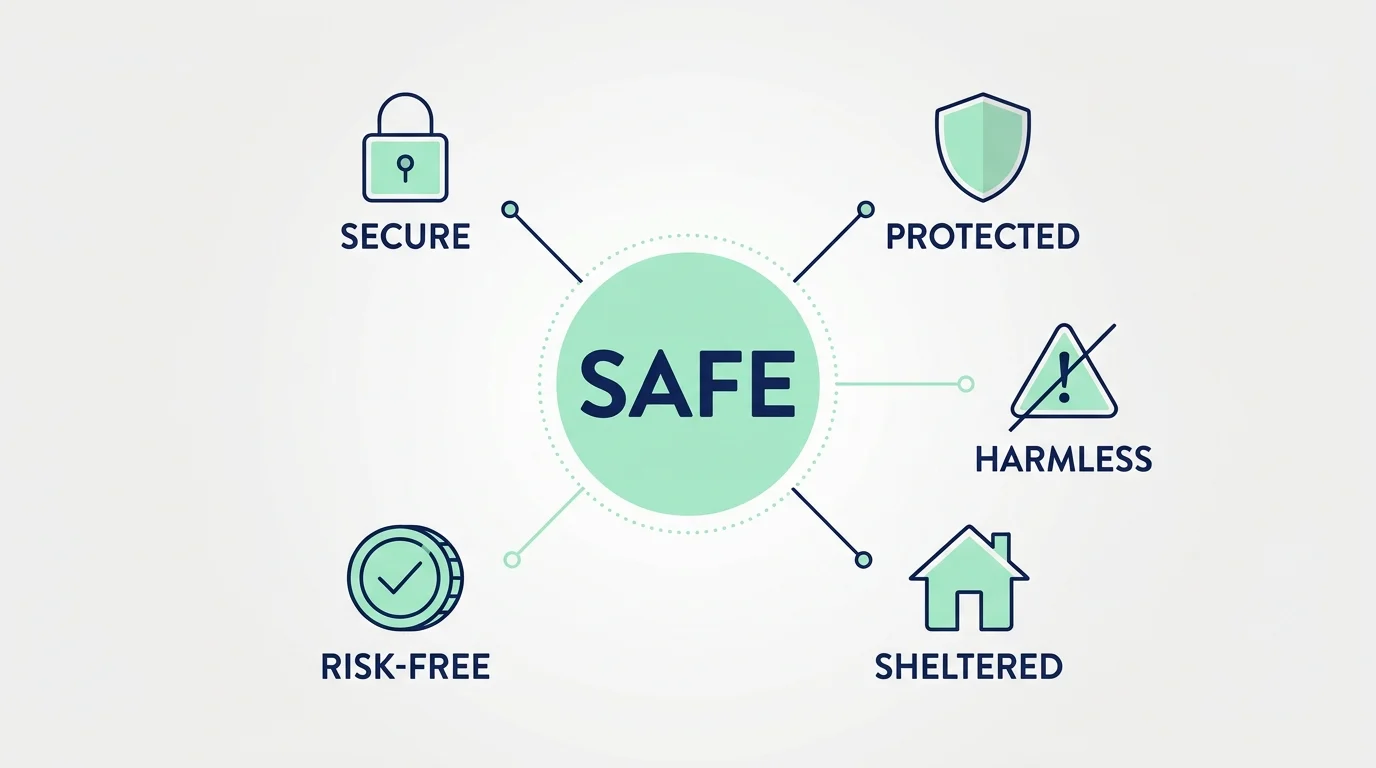
Quick Answer: Safe means free from danger, harm, or risk. Best alternatives include secure, protected, harmless, sheltered, and risk-free.
You leave your car in a crowded parking garage and spend the whole dinner wondering if it will still be there. That worry is about safety in its most physical sense. But the same word shows up in very different places: a safe investment, a safe topic for small talk, a safe driver, a safe neighborhood. Each one leans on a slightly different meaning of the word.
Some situations need a word about physical protection. Others need a word about low financial risk, emotional comfort, or a product that will not cause harm. Reaching for “safe” every time flattens your writing and hides what you actually mean. The right synonym tells the reader which kind of safety you are talking about.
What “Safe” Actually Means
Safe works mainly as an adjective. It has three common senses. The first is free from physical danger or harm, as in a safe building or a safe route. The second is free from risk of loss or failure, especially in finance and decision-making, as in a safe bet. The third is not likely to cause harm or offense, as in a safe toy or a safe topic. It can also describe a secure place, like a safe harbor, and in British English a “safe” is a metal cabinet for valuables.
Quick-Pick Table: Top 10 Synonyms for Safe
| Word | Best for | Tone |
|---|---|---|
| Secure | Locks, systems, buildings, data | Neutral / Formal |
| Protected | Legal status, animals, areas | Neutral |
| Harmless | Objects, chemicals, jokes | Neutral |
| Sheltered | People, childhoods, locations | Neutral / Softer |
| Risk-free | Investments, trials, offers | Neutral / Marketing |
| Unharmed | People and animals after an event | Neutral |
| Guarded | Information, responses, places | Neutral / Slightly formal |
| Safe and sound | Casual storytelling, good news | Casual |
| Sound | Structures, arguments, health | Neutral / Formal |
| Invulnerable | Military, security, debate | Formal / Strong |
Synonyms Grouped by Context
Words About Physical Protection
These words describe people, places, and things that are kept out of harm’s way.
Secure – Protected against threats, often through a deliberate measure like a lock, a fence, or encryption. It is more active than safe because it implies something is guarding the thing. Keep your passport in a secure drawer when you travel.
Protected – Shielded by law, rules, or physical barriers. It often appears in legal and environmental contexts. The wetland is a protected area, so no construction is allowed there.
Sheltered – Covered or shielded from harm, weather, or hardship. It carries a softer, more nurturing tone than safe. The children grew up in a sheltered valley where everyone knew each other.
Guarded – Watched over or kept under control. It can describe a place with security, or a person who is careful about what they reveal. The entrance was heavily guarded during the summit.
Fortified – Strengthened against attack, either physically or nutritionally. In buildings it means reinforced; in food it means vitamins were added. The old town is surrounded by fortified walls that date back centuries.
Impervious – Not affected or penetrated by something. It is stronger than safe and usually names what it resists. The new coating is impervious to water and rust.
Invulnerable – Impossible to harm or defeat. It is a strong, formal word used for military, security, or debate contexts. No system is truly invulnerable to a determined attacker.
Words About Low Risk
These words fit finance, decisions, and situations where the main concern is the chance of something going wrong.
Risk-free – Carrying no chance of loss. It is common in marketing and finance, though true risk-free options are rare. The bank advertised a risk-free savings account with a fixed rate.
Low-risk – Unlikely to cause problems or loss, but not entirely without risk. It is more honest than risk-free. Doctors recommended a low-risk procedure with a short recovery time.
Sound – Reliable, well-founded, and unlikely to fail. It works well for plans, investments, and arguments. She gave us sound advice about saving for a down payment.
Prudent – Careful and sensible about risk. It describes a person or a choice rather than the thing itself. It was prudent to buy insurance before the storm season began.
Reliable – Consistently good and unlikely to fail. It focuses on dependability rather than danger. We need a reliable car for the long commute.
Words About Harmlessness
When the concern is that something might hurt or offend, these words fit better than safe.
Harmless – Not able to cause injury or damage. It is direct and slightly softer than safe. The spider looks scary but is completely harmless.
Innocuous – Not harmful and not likely to cause offense. It is more formal than harmless and often describes remarks or substances. He made an innocuous comment about the weather and changed the subject.
Benign – Gentle and not dangerous, often used in medicine and weather. It is formal and reassuring. The scan showed a benign growth that needed no treatment.
Non-toxic – Not poisonous or harmful to health. It is specific to substances and products. The paint is non-toxic, so it is fine for a child’s room.
Mild – Not severe or harsh. It describes effects, flavors, and illnesses rather than physical danger. He caught a mild cold but was back at work by Monday.
Words About Emotional Comfort
Sometimes safe means feeling at ease rather than being out of danger. These synonyms capture that sense.
Reassuring – Making someone feel less worried. It describes words, news, or behavior. Her calm, reassuring tone helped the patient relax.
Comforting – Bringing a feeling of calm and support. It is warmer and more emotional than safe. The familiar smell of the kitchen was comforting after a long trip.
Unthreatening – Not causing fear or alarm. It often describes people, animals, or situations. His unthreatening manner put the new employees at ease.
Trusted – Relied on because of past experience. It focuses on confidence rather than danger. She left the keys with a trusted neighbor.
Words About Being Unharmed After Danger
These describe the outcome, not the condition beforehand.
Unharmed – Not injured or damaged after a risky event. All passengers walked away unharmed from the crash.
Unscathed – Not harmed at all, often despite a serious threat. It is slightly literary and often used for dramatic escapes. The town survived the wildfire unscathed.
Intact – Complete and undamaged. It focuses on wholeness rather than injury. The package arrived intact despite the rough handling.
Casual and Everyday Alternatives
These are the words you would actually use in conversation.
Safe and sound – A fixed phrase meaning completely unharmed, often after a journey or scare. It is warm and casual. They made it home safe and sound after the storm.
Out of harm’s way – A phrase meaning moved to a place where danger cannot reach. It is idiomatic and vivid. The kids were out of harm’s way before the fireworks started.
In good hands – A phrase meaning looked after by someone capable and trustworthy. It is casual and reassuring. Don’t worry about the dog; he’s in good hands with my sister.
When Not to Use These Words
Secure is not a casual swap for safe everywhere. A “secure neighborhood” sounds fine, but “secure from catching a cold” sounds odd; “unlikely to catch” is better.
Harmless describes things that cannot hurt you, not situations. Do not say “a harmless neighborhood” when you mean a safe one.
Invulnerable and impervious are strong and often dramatic. Using them for everyday safety makes your writing sound exaggerated.
Risk-free is overused in advertising. In careful writing, reserve it for situations where risk is genuinely zero, and prefer low-risk otherwise.
Benign is mostly medical or weather-related. Calling a person “benign” sounds strange.
Sound is not a synonym for safe in the sense of physical danger. “A sound building” means well-built, not necessarily safe from crime.
Unscathed only works after a threat has passed. You cannot describe a route as unscathed.
Safe vs. Secure
These two are the most confusable pair. Safe focuses on being free from danger or harm. Secure focuses on being protected or locked down against a specific threat. A house can be safe from floods but not secure against burglars. In finance, “safe” means low risk, while “secure” often means guaranteed or backed by collateral. Choose safe for the absence of danger and secure for the presence of protection.
Antonyms
Dangerous, unsafe, hazardous, risky, vulnerable, exposed, perilous, precarious.
FAQs
What is the best synonym for safe in formal writing?
Secure works well for physical and data protection. Sound and prudent fit decisions and plans. Choose the word that names what the thing is safe from.
What is a casual word for safe?
“Safe and sound” and “in good hands” are common in everyday speech. Harmless is the everyday word when the concern is physical harm.
Is secure the same as safe?
Not exactly. Safe means free from danger; secure means protected against a specific threat. A place can be one without the other.
What is a synonym for safe in finance?
Risk-free and low-risk are the standard terms. Sound and prudent describe the choice or the investor rather than the product.
What is the opposite of safe?
Dangerous, hazardous, and risky are the most common opposites. Vulnerable and exposed work when the focus is on lack of protection.
Conclusion
The best synonym for safe depends on what kind of danger you mean. Secure and protected fit physical threats. Risk-free and prudent fit money and decisions. Harmless and benign fit substances and effects. Match the word to the exact risk you have in mind, and your sentence will be clearer and more precise.

Charlotte Sinclair focuses on English language, word choice, and everyday expressions. She enjoys helping readers find the right words for different situations, making their writing more engaging, polished, and easy to understand.