
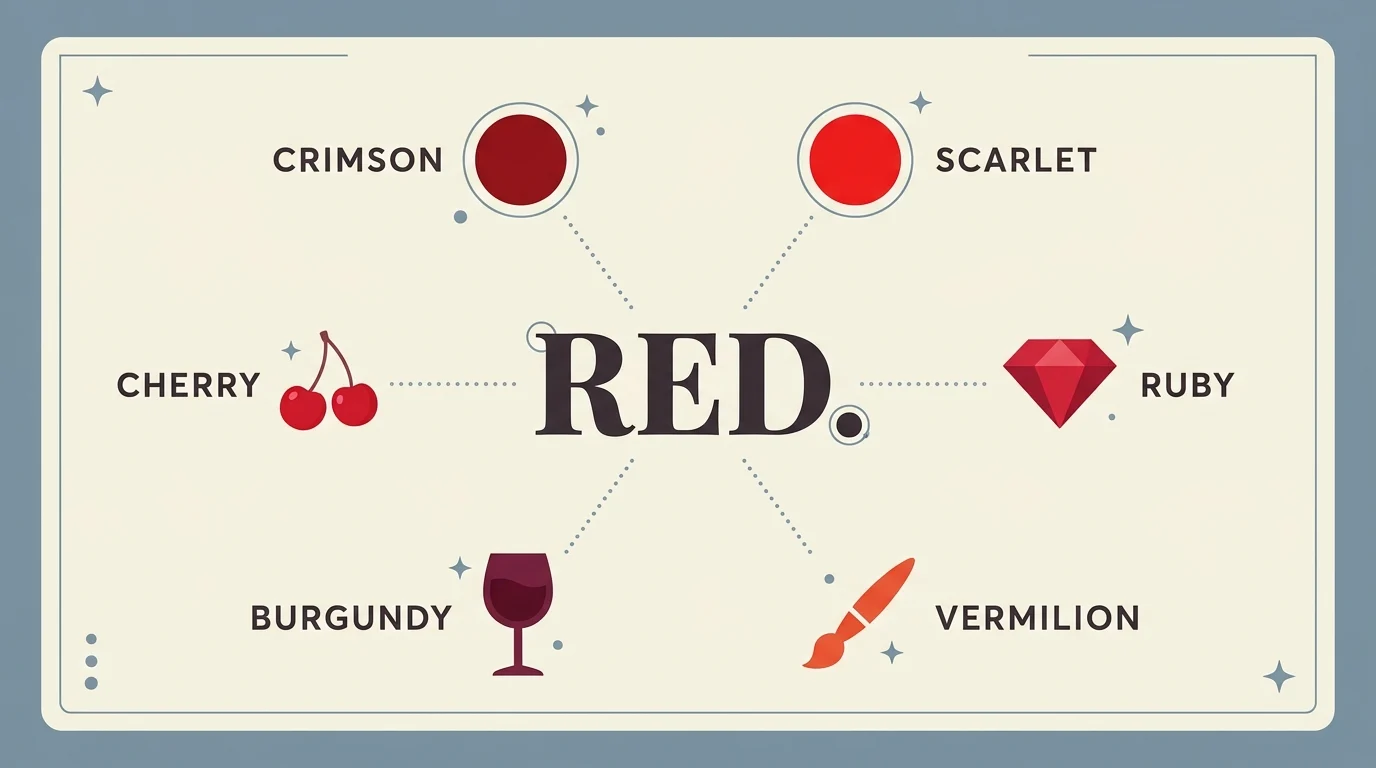
Quick Answer: Red is the color of blood, fire, and ripe fruit, and its synonyms range from crimson and scarlet to ruby and vermilion. The best alternative depends on the exact shade, the material, and the tone you want.
You are describing a sunset to a friend and “red” feels flat. The sky was not just red. It was a burning orange-red near the horizon, fading into a deep wine color above. One word cannot carry that. The same problem appears when you write about a dress, a warning sign, a political map, or a flushed face.
English has dozens of words for red, but most of them are not interchangeable. Crimson is not the same as scarlet. Ruby describes a gemstone’s glow, while vermilion describes a pigment. Some words are poetic, some are technical, and some carry strong cultural meaning. This guide sorts them by shade, material, and mood so you can pick the word that actually fits.
What “Red” Actually Means
Red is a primary color at the long-wavelength end of the visible spectrum, roughly between orange and violet. It is the color of blood, fire, and many ripe fruits. As an adjective, it describes anything of that color. As a noun, it names the color itself. Beyond the literal color, red carries strong associations: danger, passion, anger, celebration, and political movements. Those associations shape which synonym sounds right in a given sentence.
Quick-Pick Table: Top 10 Synonyms for Red
| Word | Best for | Tone |
|---|---|---|
| Crimson | Deep, rich red with a slight blue tone | Neutral / Literary |
| Scarlet | Bright, vivid red with a hint of orange | Neutral / Classic |
| Ruby | Jewel-toned, glowing red | Neutral / Descriptive |
| Vermilion | Orange-leaning pigment red | Technical / Artistic |
| Carmine | Deep pigment red from cochineal | Technical / Artistic |
| Burgundy | Dark wine red | Neutral / Fashion |
| Maroon | Dark brownish red | Neutral |
| Cherry | Bright, juicy red | Casual / Descriptive |
| Rust | Brownish orange-red | Neutral / Earthy |
| Blood-red | Vivid, dark, dramatic red | Literary / Dramatic |
Synonyms Grouped by Context
Classic Literary Reds
These words appear in poetry, fiction, and descriptive writing. They carry weight and a sense of tradition.
Crimson – A deep, rich red that leans slightly toward blue or purple. It is darker and more solemn than plain red. The curtains were a heavy crimson that made the room feel like a theater.
Scarlet – A bright, vivid red with a faint orange warmth. It is more brilliant and attention-grabbing than crimson. She wore a scarlet coat that could be spotted from across the parking lot.
Vermilion – A bright red-orange pigment color, historically made from mercury sulfide. It is more orange than scarlet and common in art writing. The temple gates were painted a striking vermilion that glowed in the afternoon sun.
Carmine – A deep, slightly cool red pigment traditionally made from cochineal insects. It is technical and often used for dyes and cosmetics. The lipstick shade was a rich carmine that suited her warm skin tone.
Ruby – A glowing, jewel-like red named after the gemstone. It suggests depth and light rather than flat pigment. The wine caught the candlelight and turned a deep ruby in the glass.
Fashion, Paint, and Design Reds
These words are common in clothing, interiors, and product descriptions where the exact shade matters.
Burgundy – A dark red with a purple or brown undertone, named after the French wine region. It is sophisticated and muted. He paired a burgundy sweater with gray trousers for the interview.
Maroon – A dark brownish red, flatter and earthier than burgundy. It is common in school uniforms and sports colors. The team’s maroon jerseys looked almost brown under the stadium lights.
Cherry – A bright, juicy red like ripe cherries. It is cheerful and casual. She repainted the front door a glossy cherry red.
Rust – A brownish orange-red like oxidized iron. It is warm and earthy rather than pure. The old truck had faded to a soft rust color near the wheel wells.
Brick – A muted, brownish red like fired clay. It is grounded and architectural. The brick-red facade blended with the older buildings on the street.
Coral – A pinkish orange-red named after the sea organism. It is softer and warmer than true red. A coral dress felt right for the beach wedding.
Technical and Artistic Reds
These terms are precise and mostly used in art, design, and manufacturing.
Cinnabar – A bright red-orange mineral and pigment, historically important in painting. It is close to vermilion but more mineral-specific. The artist ground cinnabar to get that intense orange-red.
Rose madder – A soft, slightly pink red pigment made from the madder root. It is muted and traditional. The watercolor sky was washed in rose madder and pale gold.
Alizarin – A synthetic red dye and pigment with a cool, slightly purple cast. It is common in painting and textile work. Alizarin crimson gives the shadows in that portrait their cool depth.
Cadmium red – A bright, opaque red pigment made from cadmium sulfide. It is bold and modern. The poster used cadmium red for maximum contrast against the white background.
Natural and Descriptive Reds
These words describe red as it appears in nature and everyday objects.
Blood-red – A vivid, dark, dramatic red like fresh blood. It is strong and often literary. The sky turned blood-red just before the storm hit.
Rose – A soft, pinkish red. It is gentler and more romantic than plain red. The invitation had a rose border and gold lettering.
Ruddy – A healthy, reddish flush, usually of skin or complexion. It is warm and human. His ruddy cheeks made him look like he had just come in from the cold.
Fiery – A bright, intense red-orange like flame. It suggests energy and heat. Her fiery hair stood out in the black-and-white photograph.
Wine – A deep, dark red like red wine. It is rich and slightly muted. The sofa was upholstered in a wine-colored velvet.
Stronger or More Figurative Reds
These words stretch red beyond literal color into mood and meaning.
Crimson (figurative) – Often used for embarrassment, anger, or ceremony. He went crimson when the teacher read his essay aloud.
Flushed – Reddened from heat, exercise, or emotion, usually of a face. Her cheeks were flushed after the long run.
Sanguine – A formal, literary word meaning blood-red or, more often, cheerful and optimistic. Use it carefully because the two meanings differ. The sanguine light of dusk settled over the harbor.
Incarnadine – A literary and dramatic word meaning to make red or bloody. It appears mostly in poetry and Shakespeare. The sunset incarnadined the whole western sky.
When Not to Use These Words
Scarlet and crimson are not the same. Scarlet is bright and warm; crimson is deep and cool. Swapping them can change the whole mood of a sentence.
Vermilion, cinnabar, and cadmium red are pigment terms. Do not use them for a person’s face or a casual clothing description unless you are writing technically or deliberately.
Sanguine usually means optimistic in modern English. Using it to mean “blood-red” will confuse most readers unless the context is clearly literary.
Ruddy and flushed describe skin and complexion. Do not use them for objects or landscapes.
Burgundy and maroon are close, but burgundy leans purple while maroon leans brown. In fashion and design writing, that difference matters.
Ruby is a jewel color. Avoid it for flat, matte surfaces where there is no glow.
Red vs. Rouge
Rouge is a French word for red, especially the cosmetic used on cheeks and lips. In English it is mostly a noun for makeup, not a general color adjective. “A rouge dress” sounds wrong to most native speakers; “a red dress” or “a crimson dress” is correct. Use rouge only for cosmetics or when writing deliberately in a French or fashion context.
Antonyms
Green, blue, pale, colorless, wan, ashen, pallid, white.
FAQs
What is the best synonym for red in creative writing?
Crimson, scarlet, and ruby are the strongest choices. Crimson suits deep, solemn moods, while scarlet fits bright and dramatic scenes.
What is a formal synonym for red?
Crimson and vermilion work well in formal writing. For technical contexts, cadmium red and carmine are precise options.
What is a casual word for red?
Cherry and brick are common in everyday speech. “Bright red” or “dark red” often sounds more natural than a fancy synonym in conversation.
Is scarlet the same as red?
Scarlet is a bright, vivid shade of red with a hint of orange. It is a type of red, not a perfect synonym for every use of the word.
What is the difference between burgundy and maroon?
Burgundy is a dark red with a purple undertone. Maroon is a dark red with a brown undertone.
Conclusion
Choosing a synonym for red comes down to the exact shade and the tone you want. Crimson and scarlet suit literary writing, burgundy and cherry fit fashion, and vermilion and carmine belong in art and design. Match the word to the shade and the material, and your description will land with precision.

Nathaniel Brooks writes about alternative phrases, synonyms, and practical English communication. His goal is to help readers improve their vocabulary and express themselves confidently in professional, academic, and everyday settings.