
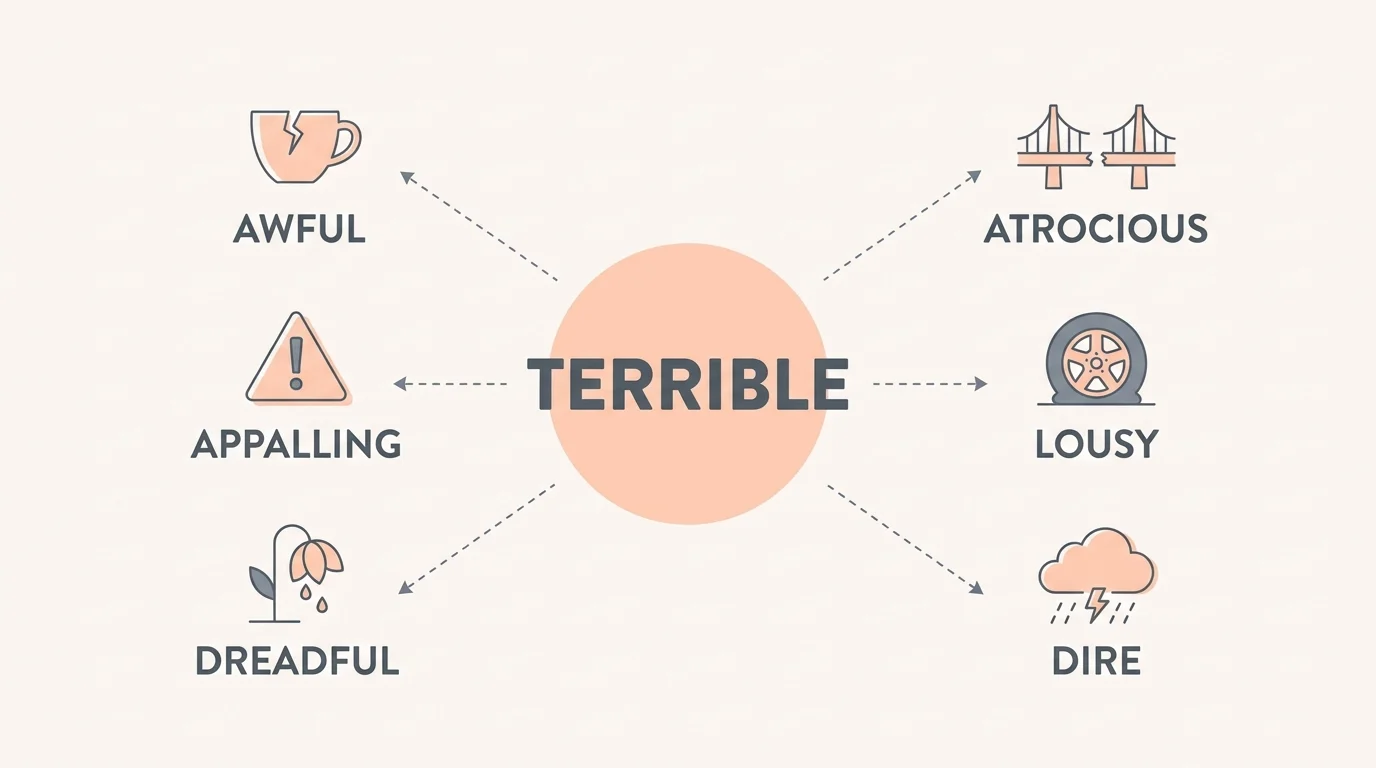
Quick Answer: Terrible means extremely bad, unpleasant, or of very low quality. Best alternatives include awful, dreadful, atrocious, abysmal, and appalling.
Your flight gets canceled at 11 p.m., the airline desk closes, and the only food left in the terminal is a stale sandwich. You tell a friend the next day: “It was terrible.” That word covers the whole night, but it flattens everything into one bland label. The sandwich was stale. The service was indifferent. The whole situation was grim. One word can’t carry all of that.
Terrible is one of the most overused words in English. It shows up for bad movies, bad weather, bad moods, and bad behavior, which means it has lost much of its punch. When you want a reader to actually feel the awfulness, you need a sharper word. The right choice depends on whether you mean low quality, moral horror, emotional misery, or just a mildly annoying day.
What “Terrible” Actually Means
Terrible is an adjective. Its main sense is “extremely bad or unpleasant,” which covers everything from a terrible meal to a terrible mistake. A second, older sense means “causing terror or fear,” as in a terrible storm or a terrible sight. That fear-based meaning is still alive in words like terrifying and terrific (which once meant fearsome). Today, the everyday sense is overwhelmingly “very bad,” and the fear sense mostly survives in set phrases like “a terrible crash.”
Quick-Pick Table: Top 10 Synonyms for Terrible
| Word | Best for | Tone |
|---|---|---|
| Awful | Everyday bad experiences, general quality | Neutral / Casual |
| Dreadful | Bad quality, weather, performances | Neutral / Slightly formal |
| Atrocious | Very bad quality, behavior, conditions | Formal / Strong |
| Abysmal | Failure, performance, results | Formal / Strong |
| Appalling | Shocking behavior or conditions | Formal / Strong |
| Horrendous | Severe experiences, mistakes, conditions | Neutral / Strong |
| Ghastly | Unpleasant, ugly, or shocking things | British / Slightly old-fashioned |
| Lousy | Everyday disappointment, casual complaints | Casual |
| Rotten | Bad luck, bad behavior, spoiled things | Casual |
| Dire | Serious bad situations, warnings | Formal / Urgent |
Synonyms Grouped by Context
Everyday and Casual Alternatives
These are the words you reach for in conversation, texts, and relaxed writing. They keep the mood light or simply exasperated.
Awful – Very bad or unpleasant, and the closest everyday swap for terrible. It is slightly softer and works for almost anything from food to weather. The coffee at the station was awful, but it did wake me up.
Lousy – Bad in a disappointing or unfair way. It often suggests a raw deal rather than pure low quality. I got a lousy seat at the back, right next to the toilet.
Rotten – Bad luck, bad behavior, or something spoiled. It has a warmer, more conversational feel than terrible. We had rotten luck with the weather all week.
Crummy – Small-scale badness, like a cheap hotel or a gloomy day. It is informal and rarely used for serious problems. The crummy motel room had a broken lamp and a dripping tap.
Dreadful – Very bad, with a slightly refined British flavor. It suits bad plays, bad manners, and bad weather equally well. The traffic on the ring road was dreadful, so we missed the opening.
Strong and Formal Alternatives
Use these when the badness is serious, and you want the sentence to carry weight.
Atrocious – Extremely bad, often with a hint of outrage. It fits poor quality, cruel behavior, and appalling conditions. The team’s defending in the second half was atrocious.
Abysmal – So bad it feels bottomless, as the root suggests. It is strongest with performance, results, and failure. Attendance at the weekly meeting was abysmal, so they scrapped it.
Appalling – Shocking and unacceptable, often morally so. It is stronger than terrible and always carries judgment. The living conditions in the shelter were appalling.
Horrendous – Extremely bad and distressing, often for experiences or mistakes. It keeps a trace of the original “horror” sense. The flight delay turned into a horrendous twelve-hour wait.
Dire – Extremely serious and urgent, often used for warnings and consequences. It implies danger, not just low quality. The report painted a dire picture of the region’s water supply.
Deplorable – Bad enough to deserve strong condemnation. It is formal and mostly used for conditions, conduct, or standards. The safety record at the plant was deplorable.
Words for Low Quality and Poor Performance
These target things that are badly made, badly done, or simply not good enough.
Shoddy – Badly made or done, often with cheap materials or careless work. It implies a corner was cut. The shoddy shelving collapsed the first time we loaded it.
Substandard – Below the required or expected standard. It is neutral and technical, common in inspections and reports. The batch was rejected for substandard packaging.
Wretched – Miserable and of very poor quality, often for conditions or experiences. It carries a note of pity. They spent the night in a wretched little room above the bar.
Pathetic – So weak or inadequate that it invites contempt or pity. It is harsh when aimed at people or efforts. His pathetic excuse for being late fooled no one.
Pitiful – Arousing pity through weakness or inadequacy. It is softer than pathetic and more sympathetic. The team put in a pitiful effort and lost by four goals.
Words for Unpleasant and Shocking Things
These fit sights, smells, and situations that are physically or emotionally hard to take.
Ghastly – Shockingly unpleasant, often for appearances, colors, or injuries. It is common in British English. The hotel lobby was painted a ghastly shade of green.
Grim – Bleak, depressing, and without hope. It suits news, weather, and situations rather than products. The forecast for the weekend looked grim.
Hideous – Extremely ugly or unpleasant to look at. It is vivid and often used for design and appearance. That hideous wallpaper had to go before we moved in.
Vile – Disgusting and morally or physically repulsive. It is strong and often used for smells, tastes, and behavior. A vile smell drifted up from the drains.
Sickening – So bad it makes you feel physically or morally ill. It often describes cruelty, violence, or a sudden shock. The sickening crunch told us the ladder had snapped.
Intensifiers and Informal Boosters
Sometimes the fastest fix is not a new synonym but a stronger modifier. “Absolutely terrible,” “truly awful,” and “downright dreadful” all work, though they add words rather than precision. For a single-word upgrade in casual speech, godawful and woeful are common. Woeful is slightly formal and pairs well with performance, ignorance, and lack. The team’s woeful passing cost them the match.
When Not to Use These Words
Abysmal and atrocious are strong. Do not use them for a mildly bad sandwich; you will sound theatrical. Save them for genuine failure or outrage.
Pathetic is a trap. It often insults people rather than describing things, and it can come across as cruel. Use it carefully and rarely.
Ghastly sounds dated or very British in American English. It is fine in the right voice, but it can read as a costume.
Sickening and vile imply physical disgust. Do not use them for minor annoyances like a slow website.
Dire is about seriousness and danger, not quality. “A dire movie” is wrong; “a dire situation” is right.
Shoddy is specific to workmanship and materials. It does not fit bad weather or bad moods.
Terrible vs. Terrific
These two look like opposites, and today they are. But both come from the same root meaning “terror.” Terrific once meant “causing terror,” and it shifted to “very good” only in the twentieth century. So a line like “a terrific storm” in old writing meant a fearsome one, not a pleasant one. If you read older texts, watch for that older sense.
Antonyms
Excellent, wonderful, superb, outstanding, delightful, pleasant, first-rate, marvelous.
FAQs
What is the best synonym for terrible?
Awful is the safest everyday swap. For stronger emphasis, atrocious or abysmal work better in formal writing.
What is a formal synonym for terrible?
Atrocious, appalling, and deplorable are strong formal choices. Substandard is the neutral, technical option for quality.
What is a casual word for terrible?
Lousy, crummy, and rotten are common in speech. “Godawful” is stronger and more informal.
Is dreadful the same as terrible?
They are very close. Dreadful often sounds slightly more refined or British, while terrible is more general and more common in American English.
What is the difference between terrible and horrendous?
Horrendous is stronger and keeps more of the original sense of horror. It suits distressing experiences, while terrible can describe almost anything mildly bad.
Conclusion
Picking a synonym for terrible comes down to how bad the thing really is and who you are writing for. Awful and lousy fit daily complaints. Atrocious and abysmal carry real weight. Appalling and deplorable add moral judgment. Match the strength of the word to the strength of the situation, and your writing will hit harder than “terrible” ever could.

Charlotte Sinclair focuses on English language, word choice, and everyday expressions. She enjoys helping readers find the right words for different situations, making their writing more engaging, polished, and easy to understand.
1 thought on “Synonyms for Terrible: 26 Better Words for “Very Bad” (Meaning & Examples)”