
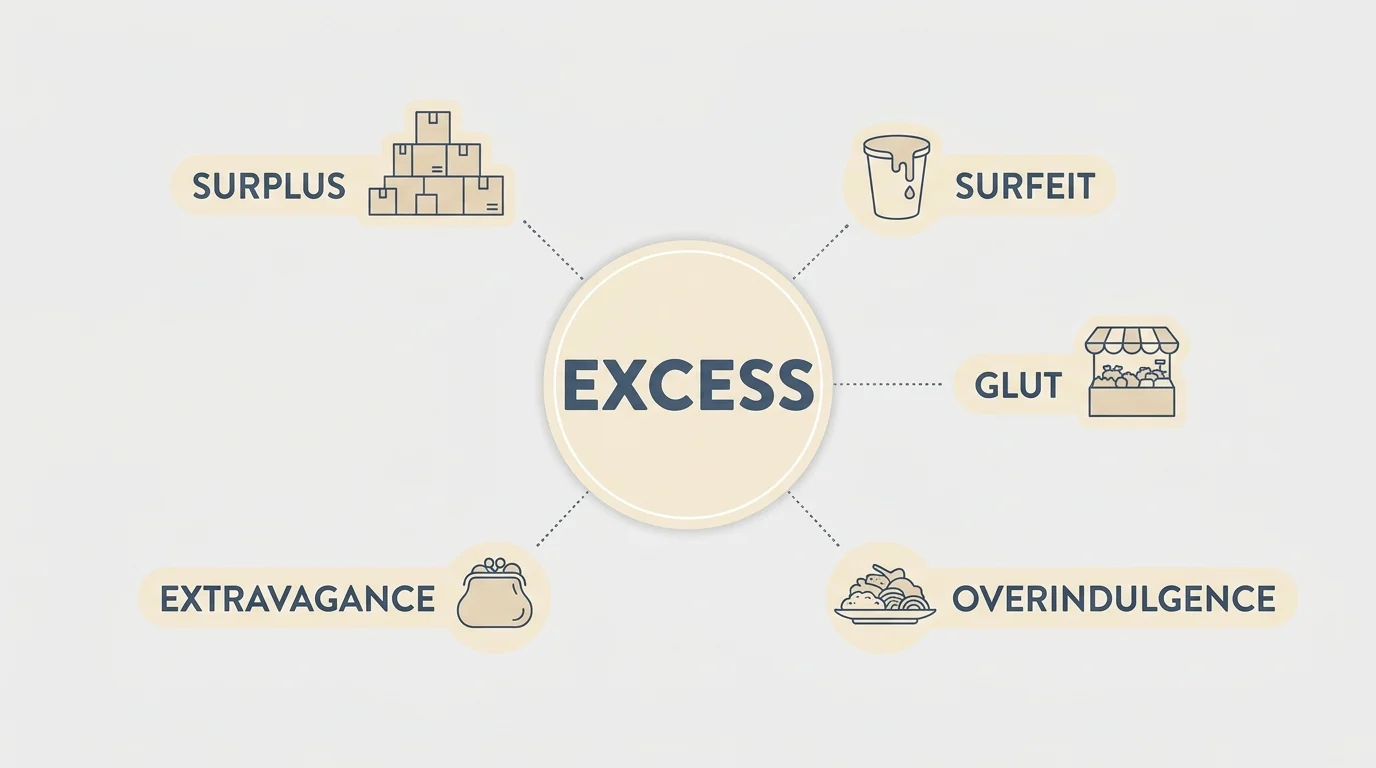
Quick Answer: Excess means an amount that is more than necessary, reasonable, or permitted. Best alternatives include surplus, surfeit, overabundance, glut, and superfluity.
You buy a family-size bag of chips for a small gathering. By the end of the night, half the bag is still sitting there, and you have nowhere to put it. That leftover pile is excess in its simplest form. But the same word also describes spending habits, emotional reactions, and even moral behavior. A single replacement like “too much” rarely captures the specific kind of extra you mean.
Some situations call for a neutral, technical word for leftover inventory. Others need a sharper word for wasteful indulgence or a formal term for a supply that outpaces demand. The right synonym depends on whether you are talking about stuff, behavior, or intensity. This guide separates those contexts so you can pick a word that fits the sentence, not just the definition.
What “Excess” Actually Means
Excess works as both a noun and an adjective. As a noun, it has two main senses. The first is a quantity that goes beyond what is needed or allowed, like extra food, inventory, or weight. The second is a pattern of behavior that goes beyond reasonable limits, often involving indulgence or lack of restraint. As an adjective, it describes something that is more than required, such as excess baggage or excess capacity.
Quick-Pick Table: Top 10 Synonyms for Excess
| Word | Best for | Tone |
|---|---|---|
| Surplus | Leftover goods, budget amounts, inventory | Neutral / Formal |
| Surfeit | An unpleasant or overwhelming amount | Formal |
| Overabundance | Supply that far outstrips demand | Neutral / Formal |
| Glut | Market oversupply, too much of a product | Neutral / Journalistic |
| Superfluity | Unnecessary extra that serves no purpose | Formal |
| Plethora | An overwhelming number of options or things | Neutral / Slightly formal |
| Overload | Systems, schedules, stress, information | Neutral |
| Extravagance | Spending, lifestyle, decorative choices | Neutral / Critical |
| Overindulgence | Eating, drinking, pampering, habits | Neutral / Critical |
| Spare | Physical objects, extra items kept on hand | Casual / Neutral |
Synonyms Grouped by Context
Neutral and Formal Alternatives for “Extra Amount”
These words work well in reports, analysis, and everyday descriptions of supply and quantity without adding moral judgment.
Surplus – The amount left over after needs are met. Unlike excess, surplus often carries a neutral or even positive tone, especially in budgeting and agriculture. The warehouse sold its surplus furniture at a deep discount.
Overabundance – A supply that is far greater than what is required. It emphasizes the sheer volume rather than the wastefulness. An overabundance of cheap imports drove local prices down.
Glut – An economic or market condition where supply exceeds demand. It is sharper than excess and usually implies a problem for sellers. A glut of unsold apartments pushed rent prices lower across the city.
Superfluity – A formal word for something unnecessary because there is already enough. It often points to a specific item or feature that serves no real purpose. The extra cup holder felt like a superfluity in a car this small.
Plethora – An amount that feels overwhelming, often used with countable things. It is slightly formal and frequently appears in writing about options or choices. The website offers a plethora of templates, most of which look nearly identical.
Surfeit – An amount so large that it becomes unpleasant or excessive. It carries a sense of saturation or weariness. After weeks of holiday parties, she felt a surfeit of small talk and cheap wine.
Words for Behavior and Indulgence
When excess describes how someone acts rather than what they have, these synonyms fit better.
Overindulgence – Giving in to desires or pleasures beyond what is healthy or sensible. It often appears in discussions of food, drink, and parenting. A weekend of overindulgence left him craving nothing but water and sleep.
Extravagance – Spending or using more than necessary, often with a hint of showiness. It differs from excess because it specifically involves resources, especially money. The wedding was criticized for its extravagance during a regional recession.
Intemperance – A formal, somewhat old-fashioned word for lack of restraint, especially with alcohol or emotions. It is stronger and more judgmental than excess. His intemperance at the dinner table embarrassed the entire family.
Profligacy – Reckless, wasteful spending or use of resources. It is a harsh, formal term used mostly in political and financial writing. Critics blamed the city’s profligacy for the budget shortfall.
Casual and Everyday Alternatives
These are the words you would actually use in conversation or informal writing.
Overload – Too much of something that creates strain, like work, information, or stress. It is common in everyday speech and tech contexts. She took on an overload of projects and ended up working every weekend.
Spare – An extra item kept in case it is needed. Unlike excess, spare has a practical, useful feel. Keep a spare phone charger in your bag for emergencies.
Leftover – The remaining part of something after the main use or meal. It is neutral and concrete. We turned the leftover rice into a quick stir-fry.
Overkill – Way more than what is needed, often to a ridiculous degree. It is casual and slightly humorous. Bringing three backup drives for a one-hour presentation was pure overkill.
Excess baggage – A fixed phrase for literal extra luggage or, figuratively, emotional or personal burdens. The figurative use is common in self-help and relationship writing. He carried a lot of excess baggage from his previous job into the new team.
Stronger or More Critical Alternatives
Use these when you want to emphasize waste, unreasonableness, or a problematic degree.
Inordinate – Beyond what is reasonable or expected, often with a sense of unfairness. It is an adjective, not a noun. The inordinate delay in refunds frustrated thousands of customers.
Exorbitant – Unreasonably high, almost always used with prices, fees, or costs. It is sharper and more specific than excessive. The hotel charged exorbitant rates during the conference week.
Unconscionable – So extreme that it feels morally wrong or unacceptable. It is a strong, formal word used in legal and ethical discussions. The company’s unconscionable waste of resources drew public backlash.
Immoderate – Lacking restraint or balance. It is a formal adjective that pairs well with nouns like ambition, spending, or enthusiasm. His immoderate ambition cost him his closest friendships.
Adjective Forms for “More Than Needed”
When you need to describe the thing itself rather than the amount, these adjectives replace “excess” before a noun.
Superfluous – Unnecessary because more than enough already exists. It often describes words, steps, or features that could be removed. The editor cut three superfluous paragraphs that repeated the same point.
Redundant – No longer needed because its function is already covered by something else. In British English, it can also mean laid off from a job. The second safety check felt redundant after the first inspection passed.
Supernumerary – Extra beyond the usual or required number. It is formal and often used in technical, theatrical, or staffing contexts. The supernumerary staff were sent home once the event was fully staffed.
Unwanted – Not desired, even if it is extra. Unlike excess, unwanted adds an emotional layer of rejection. The charity shop accepts unwanted clothing in good condition.
When Not to Use These Words
Surplus is not a synonym for misbehavior. Do not say “a surplus of drinking” when you mean excessive drinking. Surplus is for quantities, not conduct.
Plethora originally meant an unhealthy overabundance, but modern usage has softened it. Still, avoid it in very casual conversation where “a lot” would sound more natural. Also, it pairs with countable nouns; “a plethora of water” sounds wrong.
Glut is specifically about supply and demand. Do not use it for personal habits or emotions. “A glut of stress” is not idiomatic.
Extravagance implies money or resources. It is not the right word for eating too much or sleeping too much.
Overkill is informal. Avoid it in formal reports or academic writing where “excessive” or “unnecessary” would be more appropriate.
Intemperance and profligacy carry heavy moral or financial judgment. Using them lightly can make your writing sound preachy or out of date.
Excess vs. Excessive
These two words are closely related but not interchangeable. Excess is primarily a noun (the extra amount) or an adjective meaning “extra” (excess baggage). Excessive is always an adjective meaning “too much” or “beyond reasonable limits.” You can have an excess of something without it being excessive. A budget surplus is an excess of revenue, but it is not necessarily excessive or wasteful. Excessive always implies a judgment that the amount has crossed a line.
Antonyms
Deficiency, shortage, lack, dearth, scarcity, insufficiency, moderation, restraint.
FAQs
What is the best synonym for excess in a formal report?
Surplus works well for extra quantities in budgets and inventory. For behavioral excess, overindulgence or immoderation is more precise.
What is a casual word for excess?
Overkill and overload are common in everyday speech. “Too much” is the simplest phrase, but overkill adds a useful hint of ridiculousness.
Is surfeit the same as surplus?
Surfeit implies an amount so large that it becomes unpleasant or satiating. Surplus is neutral and simply means the amount left over after needs are met.
What is the difference between excess and excessive?
Excess is a noun or adjective meaning “an extra amount” or “extra.” Excessive is an adjective that always means “too much” or “beyond reasonable limits.”
What is a synonym for excess weight?
Spare or extra works for physical objects. For body weight, “excess weight” itself is the standard phrase; “surplus weight” is used in medical and fitness contexts.
Conclusion
The best synonym for excess depends on whether you are talking about a surplus of goods, a pattern of indulgence, or a degree that has gone too far. Surplus and glut fit supply. Overindulgence and extravagance fit behavior. Inordinate and exorbitant fit unreasonable amounts. Choose the word that matches the specific kind of “too much” you mean, and your writing will sound sharper and more natural.

Alexander Whitmore is a passionate writer and editor who specializes in English expressions, vocabulary, and effective communication. He helps readers discover clearer, more natural, and professional ways to express their thoughts.
1 thought on “Synonyms for Excess: 25+ Better Words for “Too Much” (Meaning & Examples)”