
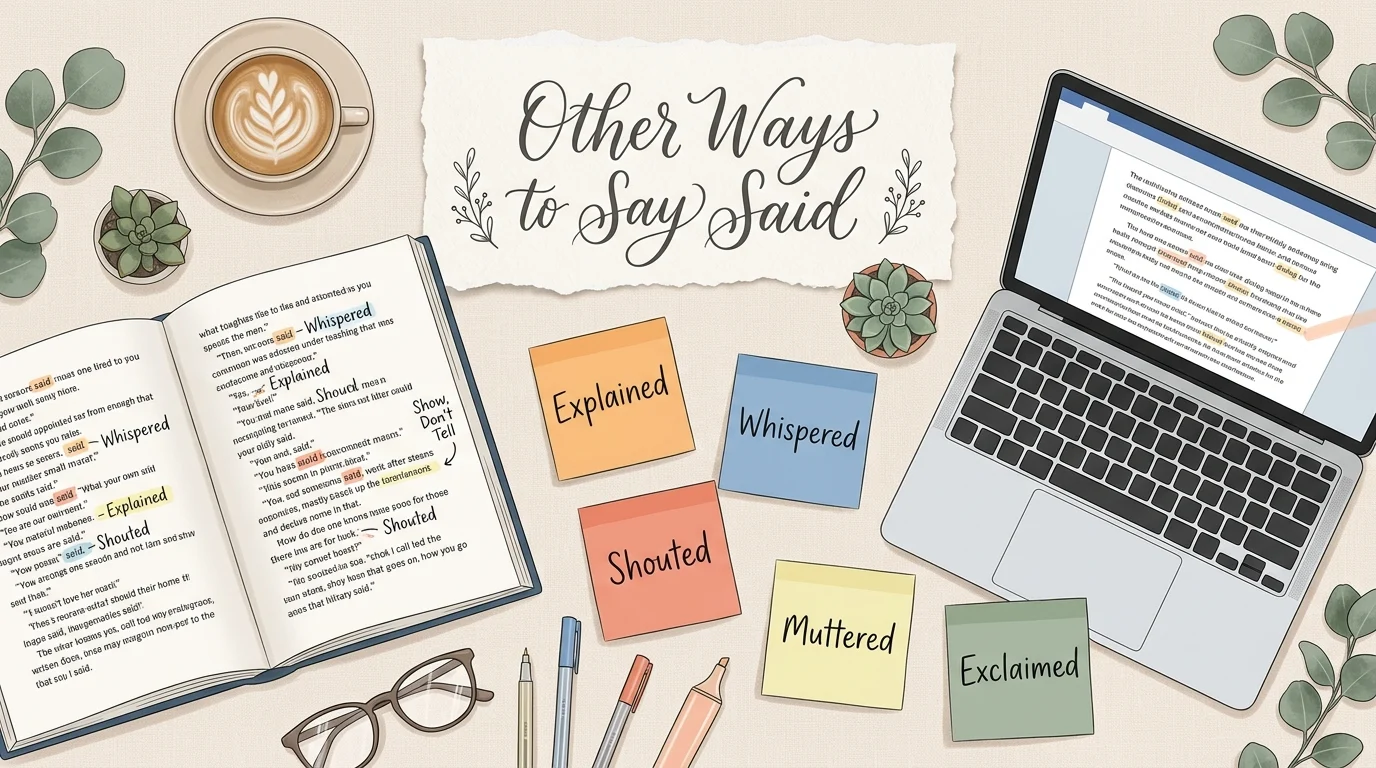
Quick Answer: Instead of saying “said,” you can use words like “stated,” “mentioned,” “explained,” “whispered,” “shouted,” “replied,” or “added” depending on whether you are writing a story, a news article, an academic paper, or a casual message.
You are writing a story, an essay, or a report, and the word “said” keeps appearing. Your dialogue feels flat, and your writing sounds repetitive. You want something fresher that still feels natural and appropriate.
The word “said” means to speak or express something in words. People use it in stories, news articles, interviews, and everyday writing to report speech. It is simple, neutral, and widely understood.
Learning alternatives to “said” helps you avoid repetition and match your tone to the situation. A novel needs different words than a news report. This is a core writing skill, not just vocabulary building.
With years of experience writing fiction, journalism, and business content, I have seen how small word choices change the emotion and rhythm of writing. The right verb shows how something was said, not just what was said. You can choose from formal alternatives and informal expressions in English.
Quick Categories
Formal Alternatives to “Said”
- Stated
- Declared
- Asserted
Pro Tip: Use these in news reports, academic writing, or official statements.
Casual Alternatives
- Went
- Was like
- Told me
Pro Tip: Save these for conversations, texts, or relaxed blog posts.
Professional Alternatives
- Explained
- Noted
- Mentioned
Pro Tip: These work for business emails, reports, or presentations.
Emotional and Expressive Alternatives
- Whispered
- Shouted
- Muttered
Pro Tip: Use these in storytelling and creative writing to show emotion.
Common Mistakes
- Incorrect: “He said me…”
Correct: “He told me…” or “He said to me…” - Incorrect: “She said that she is tired” (in past tense narration).
Correct: “She said that she was tired.” - Incorrect: Using “said” with a question.
Correct: Use “asked” for questions. - Incorrect: Overusing dramatic verbs like “exclaimed” or “retorted.”
Correct: Use “said” or “told” most of the time for clarity. - Incorrect: “He said loudly.”
Correct: “He shouted.” or “He said in a loud voice.”
What Does “Said” Mean?
It is the past tense of “say,” meaning to speak or express something in words. Grammatically, “said” functions as a verb and is often followed by a clause or a prepositional phrase.
Example: “She said she would be late.”
When to Use “Said”
- In dialogue tags in fiction
- In news reporting
- In academic citations
- In business emails and reports
- In casual conversations and texts
Spoken vs Written: Common in both, especially in reported speech.
Formal vs Informal: Neutral. Works in almost every context but can feel repetitive without variety.
Is It Polite and Professional to Say “Said”?
Yes, it is polite. It is also professional in most writing and speaking contexts. The word is neutral, clear, and rarely inappropriate. However, in creative writing, it can feel flat if overused.
Politeness means showing clarity and consideration. Professionalism means matching your audience and purpose.
Business style example: “The manager said the project would be completed by Friday.”
Verdict: Polite? Yes. Professional? Yes, in most contexts. Use alternatives to add emotion or variety.
Pros and Cons of Using “Said”
Pros:
- Universally understood and neutral
- Keeps writing clear and simple
- Short and easy to include
- Works across many contexts
Cons:
- Overused and can feel repetitive
- Lacks emotion or tone
- Can make dialogue feel flat
- Needs variety for engaging writing
Other Ways to Say “Said” (With Examples)
These alternatives will help you sound more fluent, confident, and natural in different situations. Use them according to tone, context, and audience.
Formal Alternatives
- Phrase: Stated
Meaning: Said something clearly and formally.
Explanation: Formal and precise.
Example Sentence: “The CEO stated that profits had increased.”
Best Use: News reports
Worst Use: Casual chats
Tone: Formal, clear, direct
Context Variability:- Casual: N/A
- Professional: “The report stated the facts clearly.”
- Spoken: N/A
- Phrase: Declared
Meaning: Announced something officially or firmly.
Explanation: Formal and emphatic.
Example Sentence: “The government declared a state of emergency.”
Best Use: Official statements
Worst Use: Everyday conversation
Tone: Formal, firm, official
Context Variability:- Casual: N/A
- Professional: “She declared the meeting open.”
- Spoken: N/A
- Phrase: Asserted
Meaning: Stated confidently without proof.
Explanation: Formal and strong.
Example Sentence: “He asserted that the policy would work.”
Best Use: Academic writing
Worst Use: Casual texts
Tone: Formal, confident, strong
Context Variability:- Casual: N/A
- Professional: “The author asserted her position.”
- Spoken: N/A
- Phrase: Remarked
Meaning: Said something casually or briefly.
Explanation: Formal and slightly softer.
Example Sentence: “She remarked that the weather was unusual.”
Best Use: Formal writing
Worst Use: Quick chats
Tone: Formal, light, observant
Context Variability:- Casual: N/A
- Professional: “He remarked on the progress.”
- Spoken: N/A
Professional Alternatives
- Phrase: Explained
Meaning: Made something clear.
Explanation: Professional and helpful.
Example Sentence: “The manager explained the new process.”
Best Use: Business emails
Worst Use: Fiction dialogue
Tone: Professional, clear, helpful
Context Variability:- Casual: “She explained it to me.”
- Professional: “He explained the results.”
- Spoken: “Let me explain.”
- Phrase: Noted
Meaning: Mentioned or observed something.
Explanation: Professional and neutral.
Example Sentence: “She noted that sales were up this quarter.”
Best Use: Reports
Worst Use: Emotional scenes
Tone: Professional, neutral, observant
Context Variability:- Casual: “He noted it was late.”
- Professional: “The report noted a trend.”
- Spoken: “I noted that too.”
- Phrase: Mentioned
Meaning: Referred to something briefly.
Explanation: Neutral and workplace-friendly.
Example Sentence: “He mentioned that the deadline was moved.”
Best Use: Team emails
Worst Use: Dramatic writing
Tone: Professional, friendly, neutral
Context Variability:- Casual: “She mentioned you.”
- Professional: “As mentioned earlier…”
- Spoken: “He mentioned it to me.”
- Phrase: Added
Meaning: Said something extra.
Explanation: Professional and connective.
Example Sentence: “She added that the team had done well.”
Best Use: Reports
Worst Use: Intense dialogue
Tone: Professional, neutral, connective
Context Variability:- Casual: “He added a joke.”
- Professional: “She added further details.”
- Spoken: “I will add one thing.”
Casual Alternatives
- Phrase: Went
Meaning: Said (in casual storytelling).
Explanation: Very informal and common in speech.
Example Sentence: “Then he went, ‘I told you so.'”
Best Use: Conversations
Worst Use: Formal writing
Tone: Casual, relaxed, informal
Context Variability:- Casual: “So she went, ‘No way.'”
- Professional: N/A
- Spoken: “And then he went…”
- Phrase: Was like
Meaning: Said (in casual storytelling).
Explanation: Very informal and common in speech.
Example Sentence: “She was like, ‘I can’t believe it.'”
Best Use: Conversations
Worst Use: Academic writing
Tone: Casual, relaxed, informal
Context Variability:- Casual: “He was like, ‘What?'”
- Professional: N/A
- Spoken: “And I was like…”
- Phrase: Told me
Meaning: Informed someone directly.
Explanation: Casual and clear.
Example Sentence: “She told me the news yesterday.”
Best Use: Everyday speech
Worst Use: Formal reports
Tone: Casual, clear, friendly
Context Variability:- Casual: “He told me to wait.”
- Professional: N/A
- Spoken: “She told me everything.”
- Phrase: Told
Meaning: Informed or instructed someone.
Explanation: Casual but grammatically useful.
Example Sentence: “He told her to sit down.”
Best Use: General writing
Worst Use: When no object follows
Tone: Casual, neutral, clear
Context Variability:- Casual: “I told you.”
- Professional: “She told the team.”
- Spoken: “He told me.”
Friendly and Warm Alternatives
- Phrase: Shared
Meaning: Told something personal.
Explanation: Warm and open.
Example Sentence: “She shared that she was moving.”
Best Use: Blog posts
Worst Use: News reports
Tone: Warm, personal, friendly
Context Variability:- Casual: “He shared the news.”
- Professional: “She shared her feedback.”
- Spoken: “Thanks for sharing.”
- Phrase: Revealed
Meaning: Made something known.
Explanation: Slightly dramatic and warm.
Example Sentence: “He revealed that he had been learning piano.”
Best Use: Feature writing
Worst Use: Casual texts
Tone: Warm, dramatic, clear
Context Variability:- Casual: N/A
- Professional: “The survey revealed a pattern.”
- Spoken: “She revealed the surprise.”
- Phrase: Confided
Meaning: Told a secret or private feeling.
Explanation: Warm and intimate.
Example Sentence: “She confided that she was nervous.”
Best Use: Fiction, personal essays
Worst Use: Business emails
Tone: Warm, intimate, personal
Context Variability:- Casual: N/A
- Professional: N/A
- Spoken: “He confided in me.”
- Phrase: Admitted
Meaning: Said something reluctantly true.
Explanation: Warm and honest.
Example Sentence: “He admitted that he had forgotten.”
Best Use: Storytelling
Worst Use: Neutral reports
Tone: Warm, honest, reflective
Context Variability:- Casual: “I admit it.”
- Professional: “She admitted the error.”
- Spoken: “He admitted it.”
Emotional and Expressive Alternatives
- Phrase: Whispered
Meaning: Said very quietly.
Explanation: Shows softness or secrecy.
Example Sentence: “She whispered that she loved him.”
Best Use: Fiction
Worst Use: Business reports
Tone: Soft, intimate, quiet
Context Variability:- Casual: N/A
- Professional: N/A
- Spoken: “He whispered the answer.”
- Phrase: Shouted
Meaning: Said very loudly.
Explanation: Shows anger or excitement.
Example Sentence: “He shouted that the bus was leaving.”
Best Use: Fiction, news
Worst Use: Formal essays
Tone: Loud, emotional, urgent
Context Variability:- Casual: N/A
- Professional: N/A
- Spoken: “She shouted my name.”
- Phrase: Muttered
Meaning: Said in a low, unclear voice.
Explanation: Shows annoyance or shyness.
Example Sentence: “He muttered that it wasn’t fair.”
Best Use: Fiction
Worst Use: Business emails
Tone: Low, annoyed, unclear
Context Variability:- Casual: N/A
- Professional: N/A
- Spoken: “She muttered something.”
- Phrase: Yelled
Meaning: Said very loudly, often in anger.
Explanation: Strong and emotional.
Example Sentence: “She yelled that she had had enough.”
Best Use: Fiction, storytelling
Worst Use: Formal writing
Tone: Loud, angry, intense
Context Variability:- Casual: N/A
- Professional: N/A
- Spoken: “He yelled at me.”
Professional and Neutral Alternatives
- Phrase: Replied
Meaning: Answered or responded.
Explanation: Neutral and clear.
Example Sentence: “She replied that she would attend.”
Best Use: General writing
Worst Use: Overuse in dialogue
Tone: Neutral, clear, polite
Context Variability:- Casual: “He replied quickly.”
- Professional: “She replied to the email.”
- Spoken: “I replied to him.”
- Phrase: Responded
Meaning: Answered or reacted.
Explanation: Professional and neutral.
Example Sentence: “The spokesperson responded that the issue was resolved.”
Best Use: News, business
Worst Use: Casual chats
Tone: Professional, neutral, clear
Context Variability:- Casual: N/A
- Professional: “She responded to the request.”
- Spoken: N/A
- Phrase: Announced
Meaning: Made something known publicly.
Explanation: Formal and clear.
Example Sentence: “The company announced that it would expand.”
Best Use: News, business
Worst Use: Intimate scenes
Tone: Formal, public, clear
Context Variability:- Casual: N/A
- Professional: “He announced the new plan.”
- Spoken: N/A
- Phrase: Commented
Meaning: Gave an opinion or remark.
Explanation: Neutral and often used in media.
Example Sentence: “She commented that the film was powerful.”
Best Use: Reviews, news
Worst Use: Intense fiction
Tone: Neutral, observant, light
Context Variability:- Casual: “He commented on my post.”
- Professional: “She commented on the results.”
- Spoken: “He commented briefly.”
Social Media and Blog Style Alternatives
- Phrase: Posted
Meaning: Shared something online.
Explanation: Modern and digital.
Example Sentence: “She posted that she was starting a new job.”
Best Use: Social media
Worst Use: Academic papers
Tone: Modern, casual, digital
Context Variability:- Casual: “He posted a photo.”
- Professional: “She posted an update.”
- Spoken: N/A
- Phrase: Wrote
Meaning: Said something in writing.
Explanation: Neutral and common in blogs.
Example Sentence: “He wrote that the experience changed him.”
Best Use: Blog posts
Worst Use: Spoken dialogue
Tone: Neutral, digital, clear
Context Variability:- Casual: “She wrote to me.”
- Professional: “He wrote in the report.”
- Spoken: N/A
- Phrase: Tweeted
Meaning: Posted on Twitter or X.
Explanation: Modern and specific.
Example Sentence: “She tweeted that the event was sold out.”
Best Use: Social media news
Worst Use: Formal writing
Tone: Modern, casual, specific
Context Variability:- Casual: “He tweeted about it.”
- Professional: N/A
- Spoken: N/A
- Phrase: Texted
Meaning: Sent a message by phone.
Explanation: Modern and casual.
Example Sentence: “He texted that he was on his way.”
Best Use: Everyday writing
Worst Use: Formal reports
Tone: Modern, casual, clear
Context Variability:- Casual: “She texted me.”
- Professional: N/A
- Spoken: “He texted earlier.”
Pull Quotes
“Said” is clear and safe, but safe can also mean forgettable. A fresh word shows you put thought into your writing.
Tone matters more than vocabulary. “Whispered” in a news report sounds careless. “Stated” in a love scene sounds stiff.
Good writing is not about fancy words. It is about choosing the right verb for the right emotion at the right moment.
Variety works in dialogue only when you know your scene. When in doubt, choose clarity over drama.
Mini Quiz
1. You are writing a news report. Which is most appropriate?
a) “Was like”
b) “Stated”
c) “Whispered”
2. You are writing a tense scene between two characters. What should you say?
a) “Noted”
b) “Muttered”
c) “Announced”
3. Which phrase is best for a business email?
a) “Explained”
b) “Went”
c) “Tweeted”
4. You are posting on social media about a celebrity. Which fits best?
a) “Asserted”
b) “Posted”
c) “Confided”
Answers:
- (b) – Formal and clear for news reporting.
- (b) – Shows emotion and tension in fiction.
- (a) – Professional and clear for business writing.
- (b) – Modern and casual for social media.
Comparison Table
| Phrase | Tone | Best Use |
|---|---|---|
| Stated | Formal, clear | News reports |
| Declared | Formal, firm | Official statements |
| Explained | Professional, clear | Business emails |
| Noted | Professional, neutral | Reports |
| Mentioned | Professional, friendly | Team emails |
| Went | Casual, relaxed | Conversations |
| Was like | Casual, informal | Storytelling aloud |
| Whispered | Soft, intimate | Fiction |
| Shouted | Loud, emotional | Fiction, news |
| Replied | Neutral, polite | General writing |
| Posted | Modern, casual | Social media |
FAQs
What can I say instead of “said”?
You can say “stated,” “explained,” “mentioned,” “whispered,” “shouted,” “replied,” or “added” depending on context and emotion.
Is “said” formal or informal?
It is neutral. It works in almost every context, but alternatives like “stated” or “explained” sound more formal, while “went” or “was like” sound more casual.
How do you say “said” professionally in an email?
Use “explained,” “noted,” “mentioned,” or “added.” These sound professional and clear without being too stiff.
What is a strong word for “said”?
Strong words include “declared,” “asserted,” “whispered,” “shouted,” “muttered,” and “confided,” depending on the emotion you want to convey.
Is it okay to use “said” all the time?
Yes, “said” is actually preferred in most dialogue because it is invisible to readers. Use alternatives sparingly for emphasis or emotion.
Conclusion
Learning alternatives to “said” helps you sound fresh, natural, and expressive in English. You can be formal, casual, emotional, or neutral depending on who reads your message. The right word makes your writing stand out.
Practice choosing words based on tone and context. Try one new expression each time you write and notice how your writing improves. Small changes build fluency over time.
Which word will you use next time? Share this article with a colleague who wants to write better.
See Also
- Other Ways to Say “For Example”
- Other Ways to Say “Get Well Soon”
- Other Ways to Say “Happy Friday”

Nathaniel Brooks writes about alternative phrases, synonyms, and practical English communication. His goal is to help readers improve their vocabulary and express themselves confidently in professional, academic, and everyday settings.