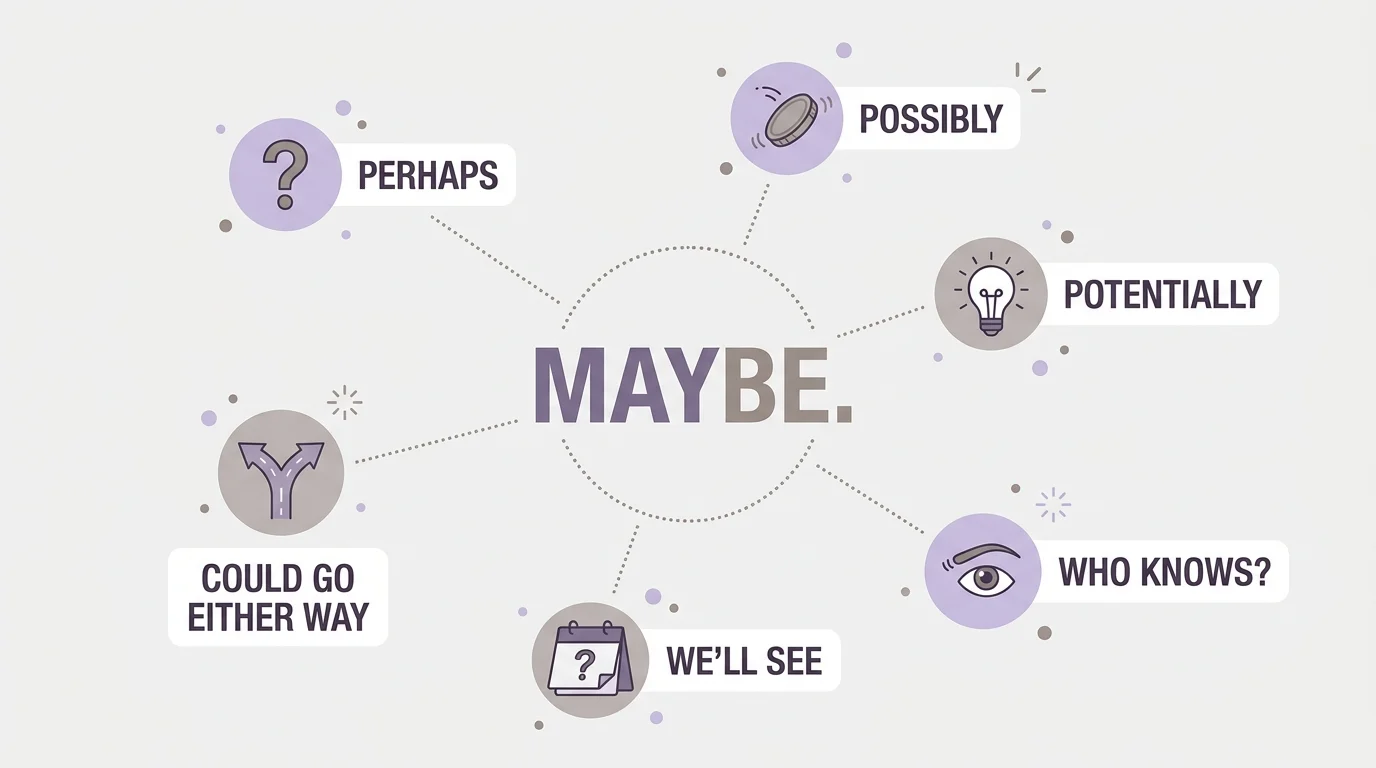
Quick Answer: Maybe means something is possible but not certain. Best alternatives include perhaps, possibly, potentially, conceivably, and perchance.
A coworker asks if you can finish the report by Friday. You pause. The honest answer is not yes and not no. “Maybe” is the word that buys you time and keeps the door open. But that same word can sound evasive in an email, too casual in a legal memo, or almost comically old-fashioned in the wrong sentence.
The problem is that uncertainty comes in different flavors. Sometimes you genuinely do not know. Sometimes you know it is unlikely but want to be polite. Sometimes you are hinting that the answer is probably no. English has a surprisingly rich set of words for this one small function, and each one carries a different level of formality, probability, or politeness.
What “Maybe” Actually Means
Maybe is an adverb. It signals that something is possible or may be true, but the speaker is not certain . It can stand alone as a one-word answer, or it can sit at the start of a sentence to soften a claim. It is one of the most common words for uncertainty in everyday English, and it is notably more informal than its closest cousin, perhaps .
Quick-Pick Table: Top 10 Synonyms for Maybe
| Word | Best for | Tone |
|---|---|---|
| Perhaps | General uncertainty, slightly elevated speech | Neutral / Polite |
| Possibly | Unknown outcomes, formal agreement | Neutral / Formal |
| Potentially | Future risks, opportunities, formal writing | Formal |
| Conceivably | Logical possibility, argumentative writing | Formal |
| Perchance | Humorous or archaic effect | Very Formal / Playful |
| Probably | Likelihood above 50 percent | Neutral |
| It could be | Casual conversation, hedging | Casual |
| We’ll see | Deferring a decision | Casual |
| I wouldn’t rule it out | Diplomatic openness | Neutral / Professional |
| Who knows? | Lighthearted admission of uncertainty | Casual |
Synonyms Grouped by Context
Neutral and Polite Alternatives
These work almost anywhere and carry no strong emotional charge.
Perhaps – The closest and safest swap for maybe. It is slightly more formal and often sounds more polite, especially in British English . Perhaps we should wait for the client’s feedback before booking the venue.
Possibly – Suggests that something has a chance of happening or being true. It is a touch more formal than perhaps and often appears when the speaker genuinely lacks information . The flight will possibly be delayed by the storm moving in from the west.
Potentially – Points to a future possibility, often one with consequences. It is common in risk assessments, planning, and formal writing. The new policy could potentially affect every department in the building.
Conceivably – Means something is imaginable or logically possible, even if unlikely. It belongs in analytical writing and careful argument. The team could conceivably finish early, but only if the vendor delivers on time.
Presumably – Signals that you are assuming something is true based on what you know. It is not pure uncertainty; it leans toward a reasonable guess. Presumably, the meeting was moved because the conference room was double-booked.
Formal and Literary Alternatives
These words raise the register of a sentence and often sound deliberate or old-fashioned.
Perchance – An archaic word that means maybe. Today it is used for formal effect or humor, and it can sound theatrical if used carelessly . If perchance the train is on time, we might catch the early show.
Peradventure – Even older and rarer than perchance. It survives mostly in the phrase “beyond peradventure,” meaning without doubt. Avoid it in modern prose unless you are aiming for a deliberate antique tone .
Mayhap – A poetic or dialectal form of perhaps. It appears in historical fiction and period dialogue, not in everyday writing .
In all likelihood – A formal phrase meaning something is probable. It is not a direct synonym for maybe because it signals a stronger probability, but it fits when you want to sound measured. In all likelihood, the results will be published by the end of the month.
Casual and Conversational Alternatives
These are the phrases you actually say out loud, often to soften a no or keep options open.
It could be – A simple, flexible hedge. It works as a standalone answer or the start of a sentence. “Will you make it to the dinner?” “It could be. Depends on how late I finish here.”
We’ll see – A gentle way to defer a decision without saying no. It can sound noncommittal, so use it with people who understand your tone. “Can we get a puppy?” “We’ll see.”
I guess so – A reluctant or uncertain agreement. It signals less enthusiasm than a plain yes. “Is this the right turn?” “I guess so, but the map looks different from here.”
Sort of – A casual hedge that softens a statement. It is common in speech but too loose for formal writing. “Are you nervous about the interview?” “Sort of, but mostly excited.”
Who knows? – A lighthearted admission that something is unknowable. It often closes a conversation rather than opening one. “Will the weather clear up by Saturday?” “Who knows? The forecast keeps changing.”
Diplomatic and Professional Alternatives
These phrases are useful when you need to stay open without committing, especially at work.
I wouldn’t rule it out – Leaves a possibility alive without promising anything. It is polite and professional . “Are you considering a move to the new office?” “I wouldn’t rule it out.”
It remains to be seen – Defers judgment until more information arrives. It sounds measured and slightly formal . Whether the merger will benefit employees remains to be seen.
There’s a chance – A straightforward, honest way to acknowledge possibility. It is softer than saying yes and clearer than saying maybe. There’s a chance the shipment arrives early, but don’t count on it.
Could go either way – Signals that two outcomes are equally likely. It is useful when you genuinely cannot predict . The vote could go either way, so both sides are still lobbying.
Words That Lean Toward Yes or No
Maybe sits in the middle, but some synonyms tilt the probability in one direction.
Probably – Leans toward yes. It suggests a likelihood greater than 50 percent, which makes it stronger than maybe . She will probably accept the offer, but she hasn’t signed yet.
Doubtfully – Leans toward no. It signals skepticism about whether something will happen. He will doubtfully agree to another extension after the last delay.
Unlikely – A clearer no-leaning word. It is more direct than maybe and leaves less room for hope. A full refund is unlikely at this stage in the process.
When Not to Use These Words
Perchance and mayhap will sound ridiculous in a work email. They are for costume, humor, or historical fiction only.
Probably is not a true synonym for maybe. It signals a stronger likelihood, so swapping it in changes the meaning of your sentence.
I guess so can sound dismissive or unenthusiastic. Do not use it when someone is asking for your genuine opinion.
Sort of is too vague for contracts, reports, or any writing where precision matters. Use possibly or potentially instead.
Who knows? can come across as flippant. Keep it for casual conversations, not professional ones.
Peradventure is almost extinct in modern English. Using it will distract readers from your point.
Maybe vs. Perhaps
This is the most common confusable pair. Both mean the same thing, but they differ in register. Maybe is informal and common in casual speech. Perhaps is neutral to slightly formal and often sounds more polite . In American English, perhaps can sound a little stiff in casual conversation, while in British English it is perfectly natural in everyday use. If you are writing an email to a client, perhaps is the safer choice. If you are texting a friend, maybe is fine.
Antonyms
Certainly, definitely, surely, undoubtedly, absolutely, positively.
FAQs
What is the best synonym for maybe?
Perhaps is the closest and safest alternative. It carries the same meaning and works in almost every context, though it sounds slightly more formal.
What is a formal synonym for maybe?
Possibly, potentially, and conceivably all work in formal writing. Perchance exists but sounds archaic or humorous in modern text.
What is a casual way to say maybe?
It could be, we’ll see, and I guess so are common in conversation. Who knows? works when you want to be lighthearted about uncertainty.
What is the difference between maybe and perhaps?
Maybe is informal, while perhaps is neutral or slightly formal. Both express the same level of uncertainty, but perhaps sounds more polite in professional settings .
Is “perchance” still used?
Only rarely. It survives as a deliberate archaism for humor or formal effect, as in “If perchance you should need me.” It is not part of everyday English .
Conclusion
The right synonym for maybe depends on who is listening and how much uncertainty you want to show. Perhaps and possibly fit professional writing. It could be and we’ll see fit conversation. I wouldn’t rule it out keeps a door open without a promise. Perchance is for a smile, not a memo. Match the word to the moment, and your uncertainty will sound intentional rather than vague.

Charlotte Sinclair focuses on English language, word choice, and everyday expressions. She enjoys helping readers find the right words for different situations, making their writing more engaging, polished, and easy to understand.