
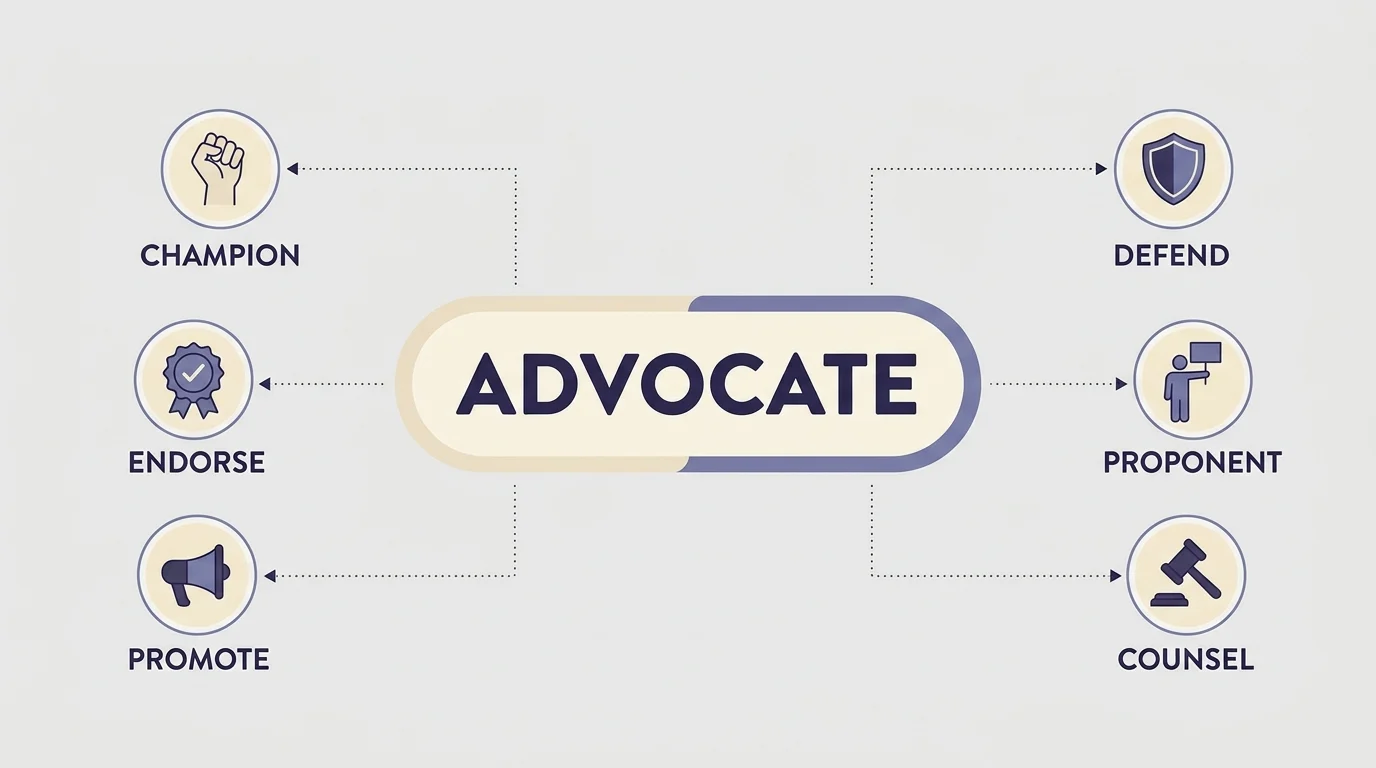
Quick Answer: Advocate means to publicly support or argue for a cause, policy, or person. Best alternatives include champion, endorse, promote, uphold, and campaign for.
A local group wants the city to add a crosswalk near a school. Someone writes letters, speaks at the council meeting, and gathers signatures. That person is an advocate. But the same label applies to a lawyer defending a client in court, a celebrity backing a charity, and a coworker who keeps pushing a good idea in meetings. The word stretches across very different kinds of support.
Some situations need a verb for active, public pushing. Others need a noun for a person who speaks for a cause. A few contexts call for a word that signals quiet backing rather than loud campaigning. Picking the right synonym means knowing whether the support is vocal, legal, financial, or moral.
What “Advocate” Actually Means
Advocate works as both a noun and a verb. As a verb, it means to support, recommend, or argue for something publicly. As a noun, it has two main senses. The first is a person who pleads for a cause or idea. The second is a legal professional who represents clients in court, especially in Scotland and some other jurisdictions . The verb form was once controversial—Benjamin Franklin complained about it in 1789—but it is now standard English .
Quick-Pick Table: Top 10 Synonyms for Advocate
| Word | Best for | Tone |
|---|---|---|
| Champion | Public defense of a cause or person | Neutral / Strong |
| Endorse | Public approval, products, candidates | Neutral / Formal |
| Promote | Spreading awareness, ideas, policies | Neutral |
| Uphold | Defending principles, laws, decisions | Formal |
| Campaign for | Organized, sustained public effort | Neutral / Active |
| Support | General backing, mild or strong | Neutral |
| Proponent | A person who argues for an idea | Formal |
| Supporter | A person who backs a cause or person | Neutral / Casual |
| Defend | Protecting something under attack | Neutral / Strong |
| Back | Financial or practical support | Casual / Neutral |
Synonyms Grouped by Context
Verbs for Public Support and Promotion
These words fit when someone is actively pushing an idea, policy, or product into public view.
Champion – To publicly defend or fight for a cause or person, especially one that is weak or under attack. It is stronger and more active than advocate, with a heroic edge. She spent years championing the rights of temporary workers.
Promote – To help something grow or become more widely known. Unlike advocate, it focuses on spreading awareness rather than arguing a position. The campaign promoted recycling in every elementary school in the district.
Endorse – To publicly declare approval or support, often for a product, candidate, or statement. It is more formal and usually carries the weight of reputation. Two former governors endorsed the infrastructure plan this week.
Campaign for – To work in an organized, sustained way toward a goal. It implies effort over time and often involves public outreach. The group has been campaigning for cleaner air standards since 2019.
Press for – To push insistently for something, often in negotiations or policy debates. It carries a sense of urgency. Residents pressed for a full investigation into the water quality.
Espouse – To adopt or support a belief, cause, or way of life. It is formal and often used for ideas rather than specific policies. The organization espouses a philosophy of community-led development .
Verbs for Defense and Protection
Use these when the support involves shielding something from attack or criticism.
Uphold – To defend or confirm something that is being challenged, especially laws, principles, or decisions. It has a formal, authoritative tone. The court upheld the city’s right to regulate short-term rentals .
Defend – To protect someone or something from criticism or harm. It is broader than advocate and can be used in both personal and legal contexts. The spokesperson defended the company’s safety record during the hearing.
Back – To give support, often financial or practical, to someone or something that needs help. It is more casual than advocate and implies lending strength. Several local businesses backed the youth sports league .
Stand up for – To defend or support a person or principle, especially when it is unpopular or difficult. It is conversational and emotionally direct. He stood up for the intern when others blamed her for the mistake.
Nouns for People Who Advocate
These words replace “advocate” when you are naming a person rather than describing an action.
Proponent – A person who argues in favor of an idea or proposal. It is formal and common in policy and academic writing. Proponents of the plan say it will reduce commute times .
Supporter – A person who backs a cause, team, or candidate. It is the most neutral and widely usable noun on this list. Supporters gathered outside the courthouse before the hearing .
Defender – A person who protects something from attack or criticism. It suggests active resistance to opposition. She became a prominent defender of press freedom .
Campaigner – A person who works actively in an organized effort for a cause. It emphasizes the work and persistence involved. He was a lifelong campaigner for disability access .
Backer – A person who provides support, often financial. It is slightly informal and common in business and politics. The project found a major backer in a local foundation .
Spokesperson – A person who speaks officially for a group or organization. Unlike advocate, it does not imply personal belief, only a formal role. A spokesperson for the hospital confirmed the new policy .
Formal and Legal Alternatives
These words fit legal, academic, or official contexts where precision matters.
Counsel – A lawyer who represents a client in court. It is the standard legal noun in American English. Defense counsel requested a recess to review the new evidence .
Pleader – A person who argues a case in court. It is less common than counsel and sounds slightly old-fashioned. The pleader made a brief but forceful argument.
Barrister – A lawyer who argues cases in higher courts, used mainly in British and Commonwealth systems. The barrister cross-examined the witness for nearly an hour .
Solicitor – A lawyer who gives legal advice and prepares documents, mainly in British usage. Her solicitor advised her not to sign the agreement .
Softer or More General Alternatives
Use these when you want to describe support without the intensity of “advocate.”
Support – To agree with and encourage something. It is the broadest and mildest word on this list, with no implication of public campaigning. Several council members support the proposal but have not spoken publicly .
Encourage – To give confidence or help something develop. It is warmer and less political than advocate. The program encourages young people to vote .
Recommend – To suggest something as a good idea. It is more about advice than public campaigning. The committee recommended that the policy be reviewed annually .
When Not to Use These Words
Endorse is not a neutral substitute for advocate. It usually implies public approval and often involves reputation or money. A person can advocate for a policy without formally endorsing it.
Promote suggests spreading awareness or helping something grow. It does not carry the sense of arguing or pleading that advocate does. Do not use it when the context involves defending something against criticism.
Counsel and barrister are legal roles, not general words for a supporter. Do not use them outside legal contexts.
Proponent is always a person, never an action. You cannot “proponent a policy.”
Back is more casual than advocate. Avoid it in formal reports where “support” or “endorse” would sound more professional.
Espouse is formal and slightly literary. Using it in casual conversation can sound stiff or out of place.
Advocate vs. Proponent
These two words are often confused because both can refer to a person who supports a cause. The key difference is grammatical. Advocate can be a verb or a noun. Proponent is only a noun. You can advocate for a policy, but you cannot proponent it. As nouns, advocate often implies active pleading and public argument, while proponent is more neutral and descriptive. A proponent of a theory simply argues for it; an advocate often campaigns for it.
Antonyms
Oppose, resist, discourage, criticize, denounce, undermine, obstruct, deter.
FAQs
What is the best synonym for advocate as a verb?
Champion works well for active, public support. Support is the safest general choice. Endorse fits formal or public approval of a person or product.
What is a formal synonym for advocate as a noun?
Proponent is the standard formal noun for a person who argues for an idea. Supporter is more neutral and widely usable.
What is a casual word for advocate?
Back and stand up for work well in conversation. Supporter is also natural in everyday speech.
What is the difference between advocate and proponent?
Advocate can be a verb or a noun. Proponent is only a noun. Advocate often implies active pleading; proponent is more neutral and descriptive.
Is advocate a lawyer?
Yes, in legal contexts advocate can mean a lawyer, especially one who pleads cases in court. This usage is common in Scotland and some other legal systems.
Conclusion
The right synonym for advocate depends on whether you need a verb or a noun, and whether the support is public, quiet, legal, or financial. Champion and campaign for fit active public pushing. Uphold and defend fit protection. Proponent and supporter fit people. Counsel and barrister fit the courtroom. Match the word to the kind of support you mean, and your sentence will do the work without overstating it.

Alexander Whitmore is a passionate writer and editor who specializes in English expressions, vocabulary, and effective communication. He helps readers discover clearer, more natural, and professional ways to express their thoughts.