
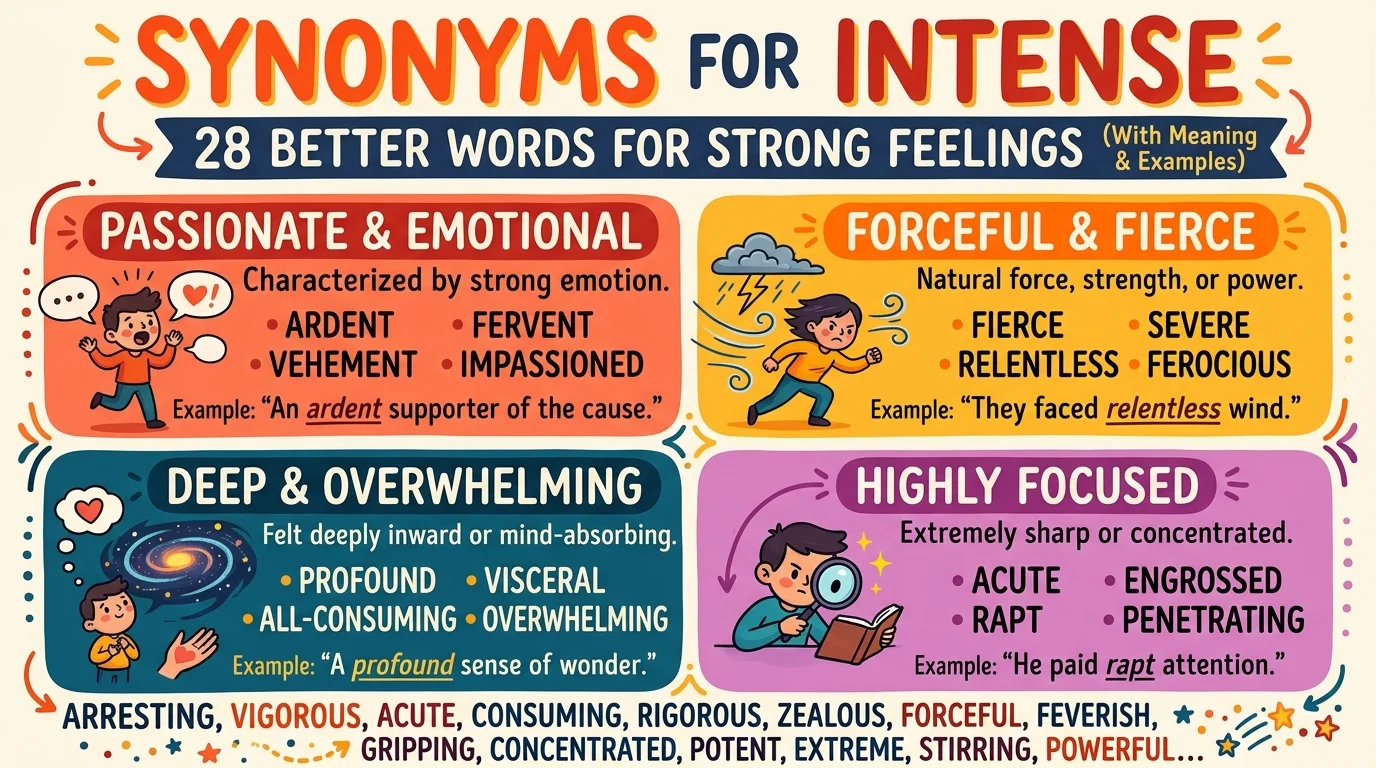
Quick Answer: Intense means very strong, extreme, or deeply felt. Best alternatives include fierce, profound, acute, vehement, and rigorous.
A thunderstorm rolls in during a power outage. The rain hammers the roof, the wind bends the trees, and nobody in the house can sleep. That is intense in its most physical form. But the same word covers a stare across a dinner table, a workout that leaves you shaking, and a debate that turns personal. The word gets stretched across weather, feelings, focus, and effort, so a single replacement rarely fits every sentence.
Some contexts call for a word about physical force. Others need a word about emotional depth, mental focus, or plain hard work. A few situations need a warning that the intensity has crossed into something unhealthy. The right synonym depends on what kind of strong you mean.
What “Intense” Actually Means
Intense is an adjective. It describes something that exists or happens to a very high degree. It covers three broad senses: physical force or severity (intense heat, intense pain), emotional or mental depth (intense feelings, intense focus), and effort or seriousness (intense training, intense scrutiny). And it is neutral on its own, but tone shifts with context. An intense workout can be admired; an intense personality can be admired or exhausting.
Quick-Pick Table: Top 10 Synonyms for Intense
| Word | Best for | Tone |
|---|---|---|
| Fierce | Competition, weather, emotions, loyalty | Neutral / Strong |
| Profound | Feelings, silence, impact, ideas | Formal |
| Acute | Pain, awareness, shortage, crisis | Formal / Clinical |
| Vehement | Opinions, denial, protest, argument | Formal |
| Rigorous | Training, testing, analysis, standards | Formal / Neutral |
| Fervent | Hopes, beliefs, support | Formal / Warm |
| Relentless | Effort, pressure, pursuit, weather | Neutral / Strong |
| Deep | Feelings, focus, silence, thought | Neutral |
| Extreme | Conditions, measures, opinions | Neutral / Strong |
| Powerful | Emotion, impact, effect, reaction | Neutral |
Synonyms Grouped by Context
Physical Force and Severity
These words fit heat, pain, weather, and any strong physical condition.
Fierce – Violent and powerful in a way that feels almost alive. It is stronger and more aggressive than intense. The fire crews worked through fierce winds to contain the blaze.
Acute – Sharp and severe, often used with pain, illness, or shortage. It is precise and clinical. He felt an acute pain in his shoulder after the lift.
Extreme – At the farthest end of a scale. Unlike intense, it points to the extremes rather than the degree. The hikers carried extra water because of the extreme heat.
Severe – Very harsh or serious, often used in weather and medical contexts. The storm caused severe flooding across three counties.
Ferocious – Savagely strong, usually about weather, attacks, or appetite. It is more vivid and dramatic. A ferocious downpour hit just as the game began.
Raging – Actively violent and out of control, especially fire, storms, or fever. The raging fever kept him awake all night.
Emotional Depth and Feeling
When the intensity lives inside a person, these words do the job better.
Profound – Deep and far-reaching, often about feelings, meaning, or impact. It suggests lasting weight rather than raw power. She felt a profound sense of relief when the results came back clear.
Deep – A simple, flexible word for strong emotion. It is quieter than intense and works in nearly any register. His voice carried deep sadness as he spoke about the loss.
Fervent – Warm, heartfelt, and sincere. It suits hopes, beliefs, and support rather than raw anger. The parents made a fervent plea for a new playground.
Vehement – Fierce in expression, especially about opinions and denials. It points to how the feeling is expressed. She was vehement in her denial of the rumor.
Passionate – Driven by strong love or belief. It is broader than intense and usually positive. He gave a passionate speech about fixing the transit system.
Ardent – Warm and devoted, often used with supporters and admirers. The club has an ardent fan base that travels to every away match.
Piercing – Sharp and penetrating, often about stares, screams, or cold. A piercing scream came from the alley.
Mental Focus and Effort
Some intensity is mental, not emotional. These synonyms fit concentration, study, and hard work.
Rigorous – Strict, thorough, and demanding. It fits testing, training, and analysis. The drug went through a rigorous approval process before release.
Relentless – Never stopping or easing. It describes effort, pressure, and pursuit. Her relentless preparation paid off during the final round.
Exhaustive – Covering every detail with nothing left out. It fits reviews, searches, and research. The auditors conducted an exhaustive review of the records.
Fervid – Heated and passionate, often about imagination or belief. It is more literary than fervent. The novel won praise for its fervid imagination.
Concentrated – Focused into a small area or short span. It fits effort, attention, and even flavors. She made a concentrated effort to finish the report by noon.
Unremitting – Never letting up, often about pressure or pain. It sounds formal and a little grim. The unremitting pressure at work finally pushed him to resign.
Informal and Conversational Alternatives
These are the words people actually say out loud.
Heavy – Serious, weighty, or hard to handle. It covers conversations, emotions, and situations. That meeting got heavy when the layoffs were announced.
Hardcore – Extremely committed or extreme in style. It is informal and often used for fans and hobbies. He is a hardcore runner who logs twenty miles on Sundays.
Full-on – Very intense and nonstop, common in British and Australian English. The weekend was full-on, with three events back to back.
Next-level – Far beyond the usual degree. It is modern slang and fits trends and performance. The new chef’s plating is next-level.
Brutal – Extremely harsh or difficult. It is negative and often used for conditions, schedules, and feedback. The training camp was brutal, but the team came out stronger.
Wicked – Used informally in some regions to mean very strong or extreme, as in “wicked cold.” It was wicked cold on the walk to the station.
Adjectives for Expressing Strong Opinion
Vehement – Already covered above, but worth repeating here for arguments. The council member was vehement in her opposition to the plan.
Strident – Loud, harsh, and insistent, often about voices or demands. It carries a critical edge. Strident complaints filled the comment section.
Impassioned – Filled with strong feeling, especially in speeches and appeals. It is warmer than strident. She made an impassioned case for the scholarship program.
Emphatic – Expressed with force and certainty. It is about firmness rather than emotion. The coach was emphatic that no one would skip practice.
When Not to Use These Words
Acute is not a general upgrade for intense. It fits pain, illness, shortages, and awareness. “An acute party” will confuse readers.
Vehement carries a tone of conflict. Do not use it for happy excitement or quiet affection.
Brutal is negative and harsh. It is not a neutral swap for a hard workout unless you want to complain.
Hardcore and next-level are slang. Keep them out of formal reports and academic writing.
Deep is far softer than intense. If you need to signal raw power, deep will sound too gentle.
Fierce can read as aggressive. In a professional document, fierce criticism may sound harsher than you intend.
Strident almost always criticizes. If you want to describe strong but reasonable demands, choose emphatic or impassioned instead.
Intense vs. Intensive
These two words look alike but do different jobs, and mixing them is one of the most common errors in professional writing. Intense describes the degree or strength of a feeling, condition, or experience: intense heat, intense fear, an intense stare. Intensive describes a concentrated, thorough approach: intensive training, intensive care, an intensive course. You feel intense pressure; you complete an intensive program. If you can swap in “very strong,” you want intense. If you can swap in “thorough and concentrated,” you want intensive.
Antonyms
Mild, weak, faint, gentle, moderate, subdued, slight, diluted.
FAQs
What is the best synonym for intense in everyday writing?
Strong, fierce, and extreme are the safest picks. They are clear and work across most contexts without sounding stiff.
What is a formal synonym for intense?
Profound, acute, and rigorous work well in formal writing. Profound suits feelings and impact, while acute fits pain and severity.
What is a casual word for intense?
Heavy, hardcore, and full-on are common in conversation. “Next-level” also works well for performance or trends.
What is the difference between intense and intensive?
Intense means very strong in degree. Intensive means thorough and concentrated. You feel intense pressure, but you complete an intensive course.
Is “intense” a positive or negative word?
It depends on context. An intense workout or performance can be admired. An intense argument or stare can feel threatening. The word itself is neutral.
Conclusion
The best synonym for intense depends on where the strength lives. Fierce and severe fit weather and physical force. Profound and deep fit feelings. Rigorous and relentless fit effort. Vehement and strident fit argument. Match the word to the source of the intensity, and your sentence will carry the right weight.

Alexander Whitmore is a passionate writer and editor who specializes in English expressions, vocabulary, and effective communication. He helps readers discover clearer, more natural, and professional ways to express their thoughts.