
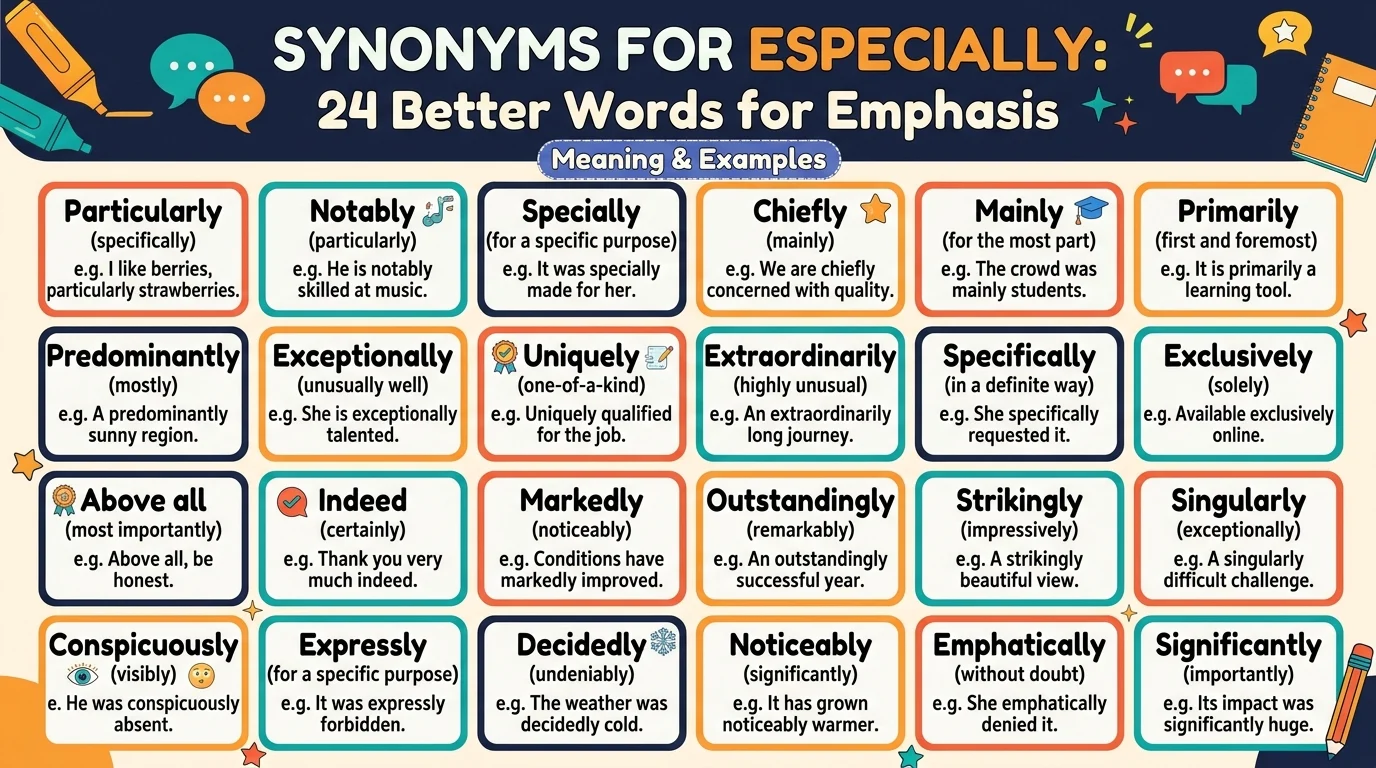
Quick Answer: Especially means more than usual or above all others in a group. Best alternatives include particularly, notably, specifically, chiefly, and exceptionally.
You are writing a warning about a hiking trail. The path is dangerous in general, but the section near the waterfall is worse than the rest. You need a word that points to that one section without saying the whole trail is equally bad. “Especially” does that job, but it is not the only word that can.
The same adverb also handles a second job: marking a high degree of something, like “especially cold” or “especially good.” That dual role is why one synonym rarely fits every sentence. A word that works for singling out a group member may sound wrong when you mean “to a great degree.” Picking well means knowing which job you are asking the word to do.
What “Especially” Actually Means
Especially is an adverb with two main senses. The first is “above all” or “more than others in a group,” as in “I love fruit, especially mangoes.” The second is “to a great degree” or “more than usual,” as in “The exam was especially difficult.” A third, narrower use means “for a particular purpose,” though “specially” is the more common choice there . The context usually makes the intended sense clear, but the right synonym changes depending on which sense you mean.
Quick-Pick Table: Top 10 Synonyms for Especially
| Word | Best for | Tone |
|---|---|---|
| Particularly | General emphasis, both senses | Neutral |
| Notably | Singling out a standout example | Neutral / Formal |
| Specifically | Precision, exact identification | Neutral / Formal |
| Chiefly | Main reason or main component | Formal |
| Mainly | General summaries, everyday writing | Neutral |
| Exceptionally | High degree, above normal | Neutral / Positive |
| Remarkably | Surprising or noteworthy degree | Neutral |
| Unusually | Degree that stands out from the norm | Neutral |
| Expressly | Purpose or intention | Formal |
| Specially | Purpose, custom-made items | Neutral |
Synonyms Grouped by Context
Neutral Alternatives for Singling Something Out
These words work in everyday writing when you want to point to one member of a group without sounding stiff.
Particularly – Above all others, or to a notable degree. It is the closest all-purpose swap for especially and fits both senses. The roads are icy, particularly on the north-facing slopes.
Notably – In a way that deserves attention. It often introduces a standout example and sounds slightly more formal than particularly. Several cities have raised minimum wages, notably Seattle and Denver.
Mainly – For the most part or as the primary reason. It is softer than especially and works well in summaries. The delay was mainly caused by a paperwork error.
Mostly – Almost entirely, with small exceptions. It is casual and common in speech. The audience was mostly students, with a few professors near the back.
Specifically – In exact terms, without ambiguity. It points to a precise item rather than a prominent one. The recall affects one model specifically, not the entire lineup.
Formal Alternatives for Emphasis
These words suit reports, analysis, and professional writing.
Chiefly – Above all other reasons or parts. It is formal and often used to explain causes. The region’s economy depends chiefly on tourism and agriculture.
Principally – For the most important reason. It is close to chiefly but slightly more emphatic. The delay was principally the result of new safety inspections.
Expressly – For a clear, stated purpose. It differs from especially because it points to intention rather than degree or prominence. The clause was added expressly to protect small vendors.
Predominantly – Mostly in terms of quantity or makeup. It describes what makes up the largest share. The neighborhood is predominantly residential, with a few shops along the main road.
In particular – A phrase rather than a single word, but a strong and natural substitute when you point to a specific example. She loves detective novels, in particular the ones set in coastal towns.
Alternatives for High Degree
These replace especially when you mean “to a great or unusual degree” rather than “above all others.”
Exceptionally – To a degree that is rare or above normal. It often carries a positive tone. The team performed exceptionally well under pressure.
Remarkably – To a degree that draws attention or surprise. It suggests something noteworthy. The old bridge has held up remarkably well despite decades of traffic.
Unusually – More than what is typical or expected. It often hints at something odd or out of place. The water was unusually warm for early spring.
Extraordinarily – Far beyond the ordinary. It is stronger than exceptionally and often used for extremes. She was extraordinarily patient with the new trainees.
Strikingly – In a way that is immediately noticeable. It often describes visual or emotional impact. The two brothers look strikingly similar until you see them side by side.
Casual and Conversational Alternatives
These are the words you would actually use in speech or informal writing.
Especially is already common in speech, but a few alternatives sound even more relaxed.
Above all – More than anything else. It is a phrase, but a natural one in conversation. Above all, don’t forget to lock the back door.
More than anything – A phrase that stresses priority or desire. More than anything, she wanted a quiet weekend at home.
Big time – To a very great degree. It is slang and should stay out of formal writing. He messed up big time on that presentation.
Way – Used as an intensifier before “too” or a comparative. It is very casual. That test was way harder than the last one.
When You Mean “For a Specific Purpose”
This sense is narrower, and only a few words fit it well.
Specially – For a particular purpose or in a particular way. It is the standard choice for custom-made or purpose-built things. She had a dress specially made for the ceremony.
Expressly – For a clearly stated purpose. It is more formal than specially and often appears in legal or official language. The funds were expressly designated for road repairs.
When Not to Use These Words
Specially and especially are not interchangeable in every sentence. Use specially for purpose (“specially designed”) and especially for prominence or degree (“especially cold”). Swapping them can make a sentence sound wrong to native ears.
Notably usually introduces an example that stands out for a reason. It is not a generic substitute for especially in the degree sense. “It was notably cold” works, but “I was notably tired” sounds slightly odd.
Remarkably carries a hint of surprise. If nothing is surprising about the degree, the word feels inflated.
Big time and way are slang or near-slang. They will undercut any formal document.
Chiefly and principally explain main causes or components. They do not work for the “high degree” sense. “Chiefly difficult” is not natural English.
Especially vs. Specially
This is the pair that trips up the most writers. Especially means “above all” or “to a great degree.” Specially means “for a particular purpose.” A gift bought specially for someone was chosen with that person in mind. A gift that is especially nice is nicer than the others. The two words overlap historically, but modern usage keeps them largely separate, and mixing them up is one of the most common usage errors in English .
Antonyms
Generally, ordinarily, commonly, normally, usually, typically, uniformly, equally.
FAQs
What is the best synonym for especially in everyday writing?
Particularly is the safest all-purpose choice. It works for both “above all” and “to a great degree,” and it sounds natural in almost any context.
What is a formal synonym for especially?
Chiefly, principally, and notably work well in formal writing. Expressly is the right pick when you mean “for a stated purpose.”
What is the difference between especially and specially?
Especially means “above all” or “to a high degree.” Specially means “for a particular purpose.” A specially made item was made for a reason; an especially nice item is nicer than usual.
Is “notably” a good substitute for “especially”?
Yes, when you are singling out a standout example. It is less natural for the high-degree sense, where particularly or exceptionally fits better.
What is a casual word for especially?
Above all and more than anything are natural in conversation. Big time and way are slang and should stay informal.
Conclusion
The right synonym for especially depends on which job the word is doing. Particularly covers both main senses safely. Notably and specifically work when you single out an example. Chiefly and principally explain main reasons. Exceptionally and remarkably handle high degree. Keep specially for purpose, and your sentences will sound precise rather than approximate.

Charlotte Sinclair focuses on English language, word choice, and everyday expressions. She enjoys helping readers find the right words for different situations, making their writing more engaging, polished, and easy to understand.