
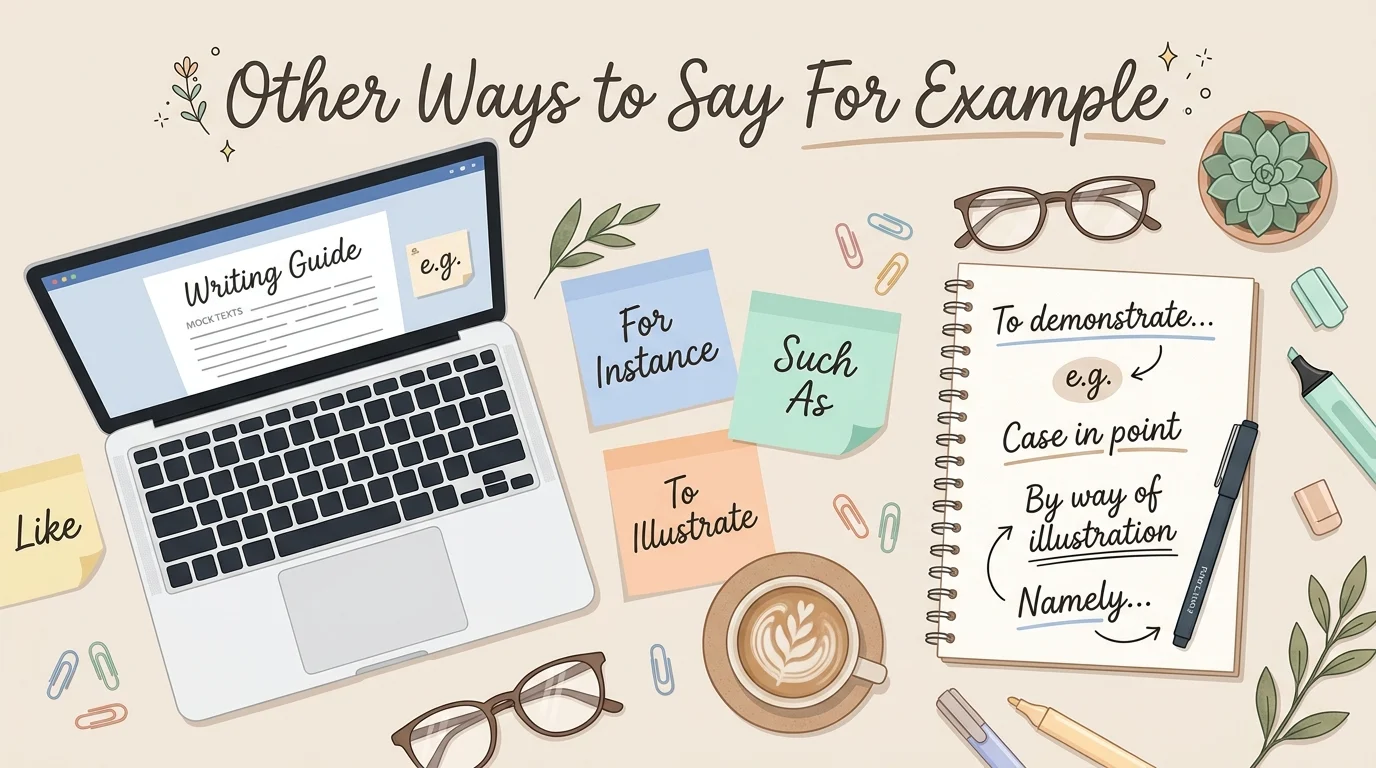
Quick Answer: Instead of saying “for example,” you can use phrases like “for instance,” “such as,” “to illustrate,” “namely,” “case in point,” or “as an example” depending on whether you are writing an academic paper, a business email, or a casual message.
You are writing an email, an essay, or a social media post, and you want to give an example. The phrase “for example” sits in your draft, but it feels repetitive. You have already used it twice, and you want something fresher that still sounds natural and appropriate.
The phrase means introducing a specific instance that clarifies or supports a general statement. People use it in writing, presentations, conversations, and everyday messages to make ideas concrete and easy to understand. It is functional, safe, and widely understood.
Learning alternatives to “for example” helps you avoid repetition and match your tone to the audience. An academic paper needs different language than a text to a friend. This is a core writing skill, not just vocabulary building.
With years of experience writing essays, business reports, and casual content, I have seen how small phrase choices change the clarity and rhythm of writing. The right words guide the reader, add emphasis, or keep things simple. You can choose from formal alternatives and informal expressions in English.
Quick Categories
Formal Alternatives to “For Example”
- For instance
- To illustrate
- Namely
Pro Tip: Use these when writing academic papers, reports, or formal business documents.
Casual Alternatives
- Like
- Say
- Take, for instance
Pro Tip: Save these for conversations, texts, or relaxed blog posts.
Professional Alternatives
- As an example
- To give you an idea
- A case in point
Pro Tip: These work for business emails, presentations, or client-facing documents.
Informal Expressions
- Such as
- Imagine this
- Just to name one
Pro Tip: Use informal expressions only in relaxed chats, not in formal academic writing.
Common Mistakes
- Incorrect: “For example’s!”
Correct: “For example!” - Incorrect: “For example of this…”
Correct: “For example, this shows…” - Incorrect: Using “for example” at the end of a sentence without a comma.
Correct: Use it at the start or middle with proper punctuation. - Incorrect: Using “for example” when listing items that are not examples.
Correct: Use “such as” for lists and “for example” for illustration. - Incorrect: “For example to say…”
Correct: “For example, you could say…”
What Does “For Example” Mean?
It is a transitional phrase used to introduce a specific instance that clarifies, supports, or explains a general statement. Grammatically, “for example” functions as a parenthetical or introductory phrase, often followed by a comma.
Example: “Many fruits are rich in vitamin C. For example, oranges and kiwis are excellent sources.”
When to Use “For Example”
- In academic essays and research papers
- In business reports and presentations
- In emails explaining a point
- In casual conversations and texts
- In blog posts and articles
Spoken vs Written: Common in both, especially in written and formal spoken contexts.
Formal vs Informal: Generally neutral to formal. Can feel stiff in very casual conversations.
Is It Polite and Professional to Say “For Example”?
Yes, it is polite. It is also professional in most writing and speaking contexts. The phrase is functional, clear, and rarely inappropriate. However, in very casual settings or creative writing, it can feel overly formal or repetitive.
Politeness means showing clarity and consideration. Professionalism means matching your audience and purpose.
Business style example: “We have seen strong growth this quarter. For example, our online sales increased by 25%.”
Verdict: Polite? Yes. Professional? Yes, in most contexts. Use alternatives to avoid repetition.
Pros and Cons of Using “For Example”
Pros:
- Universally understood and clear
- Directs reader attention to a specific point
- Short and easy to include in writing
- Works across many contexts
Cons:
- Overused and can feel repetitive
- Can sound robotic in creative writing
- May feel too formal in casual chats
- Lacks variety without alternatives
Other Ways to Say “For Example” (With Examples)
These alternatives will help you sound more fluent, confident, and natural in different situations. Use them according to tone, context, and audience.
Formal Alternatives
- Phrase: For instance
Meaning: Introduce a specific example.
Explanation: Formal and interchangeable with “for example.”
Example Sentence: “Many countries have adopted this policy. For instance, Canada and Sweden have seen positive results.”
Best Use: Academic writing
Worst Use: Casual texts
Tone: Formal, neutral, clear
Context Variability:- Casual: N/A
- Professional: “For instance, our revenue grew by 15%.”
- Spoken: “For instance, you could try a different approach.”
- Phrase: To illustrate
Meaning: Show a clear example.
Explanation: Formal and emphasizes explanation.
Example Sentence: “To illustrate, consider how a small change in habit can lead to big results.”
Best Use: Essays, reports
Worst Use: Quick chats
Tone: Formal, explanatory, clear
Context Variability:- Casual: N/A
- Professional: “To illustrate, let me share a recent case.”
- Spoken: “To illustrate, think about how this worked last time.”
- Phrase: Namely
Meaning: Specify exactly what is being referred to.
Explanation: Formal and precise.
Example Sentence: “One key factor stands out, namely the lack of proper training.”
Best Use: Academic and legal writing
Worst Use: Casual conversations
Tone: Formal, precise, direct
Context Variability:- Casual: N/A
- Professional: “One issue remains, namely the budget.”
- Spoken: N/A
- Phrase: As an illustration
Meaning: Provide a clear example.
Explanation: Formal and slightly more elaborate.
Example Sentence: “As an illustration, consider the case of a small business adapting to change.”
Best Use: Formal presentations
Worst Use: Social media
Tone: Formal, explanatory, polished
Context Variability:- Casual: N/A
- Professional: “As an illustration, here is a recent example.”
- Spoken: N/A
Professional Alternatives
- Phrase: As an example
Meaning: Simple professional way to introduce an example.
Explanation: Neutral and workplace-friendly.
Example Sentence: “As an example, our team reduced costs by 10% last quarter.”
Best Use: Business emails
Worst Use: Creative writing
Tone: Professional, neutral, clear
Context Variability:- Casual: “As an example, you could try this.”
- Professional: “As an example, consider our latest report.”
- Spoken: “As an example, think about last year.”
- Phrase: To give you an idea
Meaning: Introduce a clarifying example.
Explanation: Friendly and professional.
Example Sentence: “To give you an idea, our busiest day saw over 500 customers.”
Best Use: Client emails
Worst Use: Academic papers
Tone: Professional, friendly, helpful
Context Variability:- Casual: “To give you an idea, it was huge.”
- Professional: “To give you an idea, here are the numbers.”
- Spoken: “To give you an idea, it took three hours.”
- Phrase: A case in point
Meaning: A perfect example of what is being discussed.
Explanation: Professional and emphatic.
Example Sentence: “A case in point is the recent success of our new product line.”
Best Use: Business reports
Worst Use: Casual texts
Tone: Professional, emphatic, clear
Context Variability:- Casual: N/A
- Professional: “A case in point is our latest customer survey.”
- Spoken: “A case in point is what happened last week.”
- Phrase: Consider this
Meaning: Ask the reader to think about an example.
Explanation: Direct and engaging.
Example Sentence: “Consider this: companies that invest in training see higher retention.”
Best Use: Presentations
Worst Use: Formal reports
Tone: Professional, engaging, direct
Context Variability:- Casual: “Consider this, it worked last time.”
- Professional: “Consider this example from our data.”
- Spoken: “Consider this for a moment.”
Casual Alternatives
- Phrase: Like
Meaning: Introduce an example informally.
Explanation: Very casual and common in speech.
Example Sentence: “You can try healthy snacks, like nuts or yogurt.”
Best Use: Conversations, texts
Worst Use: Formal writing
Tone: Casual, relaxed, informal
Context Variability:- Casual: “Like, you could just ask.”
- Professional: N/A
- Spoken: “Like, for example, this one.”
- Phrase: Say
Meaning: Introduce a hypothetical example.
Explanation: Casual and conversational.
Example Sentence: “Say you want to learn a new language. You could start with an app.”
Best Use: Spoken English
Worst Use: Business emails
Tone: Casual, conversational, friendly
Context Variability:- Casual: “Say you are running late.”
- Professional: N/A
- Spoken: “Say you forgot your keys.”
- Phrase: Take, for instance
Meaning: Pick a specific example.
Explanation: Casual but clear.
Example Sentence: “Take, for instance, the way people use social media today.”
Best Use: Blog posts
Worst Use: Legal writing
Tone: Casual, clear, friendly
Context Variability:- Casual: “Take, for instance, this situation.”
- Professional: N/A
- Spoken: “Take, for instance, last summer.”
- Phrase: Just to name one
Meaning: Give a single example among many.
Explanation: Casual and informal.
Example Sentence: “There are many benefits, just to name one: better sleep.”
Best Use: Conversations
Worst Use: Academic papers
Tone: Casual, friendly, light
Context Variability:- Casual: “Just to name one, chocolate.”
- Professional: N/A
- Spoken: “Just to name one, the price.”
Friendly and Warm Alternatives
- Phrase: Such as
Meaning: Introduce examples within a list.
Explanation: Warm and common in both speech and writing.
Example Sentence: “You can enjoy many activities, such as hiking, swimming, or reading.”
Best Use: General writing
Worst Use: Formal legal documents
Tone: Friendly, neutral, clear
Context Variability:- Casual: “Such as pizza or pasta.”
- Professional: “Such as our premium plan.”
- Spoken: “Such as what?”
- Phrase: Imagine this
Meaning: Ask the reader to picture an example.
Explanation: Engaging and warm.
Example Sentence: “Imagine this: you wake up and everything is already done.”
Best Use: Storytelling
Worst Use: Technical reports
Tone: Warm, engaging, creative
Context Variability:- Casual: “Imagine this, no traffic.”
- Professional: “Imagine this scenario in your business.”
- Spoken: “Imagine this for a second.”
- Phrase: Here is one
Meaning: Introduce a single example.
Explanation: Simple and friendly.
Example Sentence: “Here is one: a simple thank-you note can brighten someone’s day.”
Best Use: Blog posts, chats
Worst Use: Formal essays
Tone: Friendly, simple, warm
Context Variability:- Casual: “Here is one, try this.”
- Professional: “Here is one example from our data.”
- Spoken: “Here is one for you.”
- Phrase: Let me give you an example
Meaning: Offer a clear example.
Explanation: Personal and helpful.
Example Sentence: “Let me give you an example of how this works in practice.”
Best Use: Explanations
Worst Use: Short texts
Tone: Warm, helpful, clear
Context Variability:- Casual: “Let me give you an example, it is easy.”
- Professional: “Let me give you an example from our case studies.”
- Spoken: “Let me give you an example.”
Informal and Humorous Alternatives
- Phrase: Case in point
Meaning: A clear example of what was just said.
Explanation: Short and punchy.
Example Sentence: “He is always late. Case in point: today.”
Best Use: Casual writing
Worst Use: Formal reports
Tone: Informal, direct, witty
Context Variability:- Casual: “Case in point, right here.”
- Professional: N/A
- Spoken: “Case in point.”
- Phrase: Exhibit A
Meaning: Humorous way to present an example.
Explanation: Playful and dramatic.
Example Sentence: “Exhibit A: the mountain of laundry in the corner.”
Best Use: Funny posts
Worst Use: Business emails
Tone: Humorous, playful, dramatic
Context Variability:- Casual: “Exhibit A, my messy desk.”
- Professional: N/A
- Spoken: “Exhibit A, right there.”
- Phrase: Need proof? Here it is
Meaning: Present an example as evidence.
Explanation: Bold and casual.
Example Sentence: “Need proof? Here it is: sales doubled after the campaign.”
Best Use: Persuasive writing
Worst Use: Formal contexts
Tone: Bold, casual, confident
Context Variability:- Casual: “Need proof? Here it is.”
- Professional: N/A
- Spoken: “Need proof? Here it is.”
- Phrase: Just look at
Meaning: Point to a clear example.
Explanation: Direct and informal.
Example Sentence: “Just look at how quickly technology changes.”
Best Use: Conversations
Worst Use: Academic writing
Tone: Informal, direct, engaging
Context Variability:- Casual: “Just look at that.”
- Professional: N/A
- Spoken: “Just look at what happened.”
- Phrase: Prime example
Meaning: A perfect or typical example.
Explanation: Emphatic and casual.
Example Sentence: “A prime example is the way people toot-watch shows.”
Best Use: Blog posts
Worst Use: Legal documents
Tone: Informal, emphatic, clear
Context Variability:- Casual: “A prime example, right there.”
- Professional: N/A
- Spoken: “A prime example is this.”
Celebratory Alternatives
- Phrase: A great example is
Meaning: Highlight a positive example.
Explanation: Warm and upbeat.
Example Sentence: “A great example is how communities came together during the storm.”
Best Use: Inspirational writing
Worst Use: Neutral reports
Tone: Warm, positive, uplifting
Context Variability:- Casual: “A great example is that one.”
- Professional: “A great example is our recent success.”
- Spoken: “A great example is what she did.”
- Phrase: One shining example
Meaning: Highlight an outstanding example.
Explanation: Emphatic and celebratory.
Example Sentence: “One shining example is the volunteer program that changed lives.”
Best Use: Speeches, tributes
Worst Use: Technical writing
Tone: Celebratory, warm, emphatic
Context Variability:- Casual: N/A
- Professional: “One shining example is our top performer.”
- Spoken: “One shining example is that project.”
- Phrase: Here is a perfect example
Meaning: Introduce an ideal case.
Explanation: Warm and confident.
Example Sentence: “Here is a perfect example of teamwork at its best.”
Best Use: Presentations
Worst Use: Casual texts
Tone: Warm, confident, positive
Context Variability:- Casual: “Here is a perfect example.”
- Professional: “Here is a perfect example from our team.”
- Spoken: “Here is a perfect example.”
- Phrase: Take this success story
Meaning: Use a positive case as an example.
Explanation: Celebratory and motivating.
Example Sentence: “Take this success story: a small startup grew into a global brand.”
Best Use: Motivational content
Worst Use: Neutral reports
Tone: Celebratory, motivational, warm
Context Variability:- Casual: N/A
- Professional: “Take this success story from our client.”
- Spoken: “Take this success story.”
Social Media Style Alternatives
- Phrase: Example in point
Meaning: Playful twist on “case in point.”
Explanation: Fun and trendy.
Example Sentence: “Example in point: my coffee addiction.”
Best Use: Social media
Worst Use: Formal emails
Tone: Trendy, fun, casual
Context Variability:- Casual: “Example in point, right here.”
- Professional: N/A
- Spoken: “Example in point.”
- Phrase: Exhibit B
Meaning: Humorous follow-up to Exhibit A.
Explanation: Playful and dramatic.
Example Sentence: “Exhibit B: the endless notifications on my phone.”
Best Use: Funny posts
Worst Use: Professional emails
Tone: Humorous, playful, casual
Context Variability:- Casual: “Exhibit B, my inbox.”
- Professional: N/A
- Spoken: “Exhibit B.”
- Phrase: Proof positive
Meaning: A clear and undeniable example.
Explanation: Bold and trendy.
Example Sentence: “Proof positive: kindness always wins.”
Best Use: Social posts
Worst Use: Client emails
Tone: Bold, positive, casual
Context Variability:- Casual: “Proof positive, right there.”
- Professional: N/A
- Spoken: “Proof positive.”
- Phrase: Need an example? Boom
Meaning: Playful way to introduce an example.
Explanation: Short and trendy.
Example Sentence: “Need an example? Boom: this viral video.”
Best Use: Social posts
Worst Use: Formal reports
Tone: Playful, trendy, energetic
Context Variability:- Casual: “Need an example? Boom.”
- Professional: N/A
- Spoken: “Need an example? Boom.”
- Phrase: And there you have it
Meaning: Conclude with a clear example.
Explanation: Warm and social.
Example Sentence: “And there you have it: a simple way to save time.”
Best Use: Social messages
Worst Use: Formal emails
Tone: Warm, social, friendly
Context Variability:- Casual: “And there you have it.”
- Professional: N/A
- Spoken: “And there you have it.”
Pull Quotes
“For example” is clear and safe, but safe can also mean forgettable. A fresh phrase shows you put thought into your writing.
Tone matters more than vocabulary. “Like” in a research paper sounds careless. “To illustrate” in a text to a friend sounds stiff.
Good writing is not about big words. It is about choosing the right words for the right reader at the right moment.
Variety works in writing only when you know your audience. When in doubt, choose clarity over cleverness.
Mini Quiz
1. You are writing an academic essay. Which is most appropriate?
a) “Like”
b) “To illustrate”
c) “Boom”
2. You are texting a close friend. What should you say?
a) “Namely”
b) “Like”
c) “As an illustration”
3. Which phrase is best for a business report?
a) “A case in point”
b) “Just look at”
c) “Need an example? Boom”
4. You are posting on social media. Which fits best?
a) “To illustrate”
b) “Proof positive”
c) “Namely”
Answers:
- (b) – Formal and explanatory for academic writing.
- (b) – Casual and natural for texting a friend.
- (a) – Professional and emphatic for business reports.
- (b) – Trendy and fun for social media.
Comparison Table
| Phrase | Tone | Best Use |
|---|---|---|
| For instance | Formal, neutral | Academic writing |
| To illustrate | Formal, explanatory | Essays, reports |
| Namely | Formal, precise | Academic and legal writing |
| As an example | Professional, neutral | Business emails |
| To give you an idea | Professional, friendly | Client emails |
| A case in point | Professional, emphatic | Business reports |
| Like | Casual, relaxed | Conversations, texts |
| Say | Casual, conversational | Spoken English |
| Such as | Friendly, neutral | General writing |
| Exhibit A | Humorous, playful | Funny posts |
| Proof positive | Bold, positive | Social posts |
FAQs
What can I say instead of “for example”?
You can say “for instance,” “such as,” “to illustrate,” “namely,” “case in point,” or “as an example” depending on context.
Is “for example” formal or informal?
It is neutral to formal. It works in most writing and speaking contexts, but alternatives like “for instance” or “to illustrate” sound more formal.
How do you say “for example” professionally in an email?
Use “as an example,” “to give you an idea,” or “a case in point.” These sound professional without being too stiff.
What does “case in point” mean?
“Case in point” means a clear or perfect example of what is being discussed. It is often used in professional and persuasive writing.
Is it okay to use “like” instead of “for example”?
Yes, in casual conversation and informal writing. Avoid it in academic or formal business writing.
Conclusion
Learning alternatives to “for example” helps you sound fresh, natural, and thoughtful in English. You can be formal, casual, funny, or warm depending on who reads your message. The right phrase makes your writing stand out.
Practice choosing phrases based on tone and context. Try one new expression each time you write and notice how your writing improves. Small changes build fluency over time.
Which phrase will you use next time? Share this article with a colleague who wants to write better.
See Also
- Other Ways to Say “Get Well Soon”
- Other Ways to Say “Happy Friday”
- Professional English Greetings for Workplace Emails

Charlotte Sinclair focuses on English language, word choice, and everyday expressions. She enjoys helping readers find the right words for different situations, making their writing more engaging, polished, and easy to understand.
1 thought on “50+ Other Ways to Say “For Example” (Casual & Professional) 2026”