
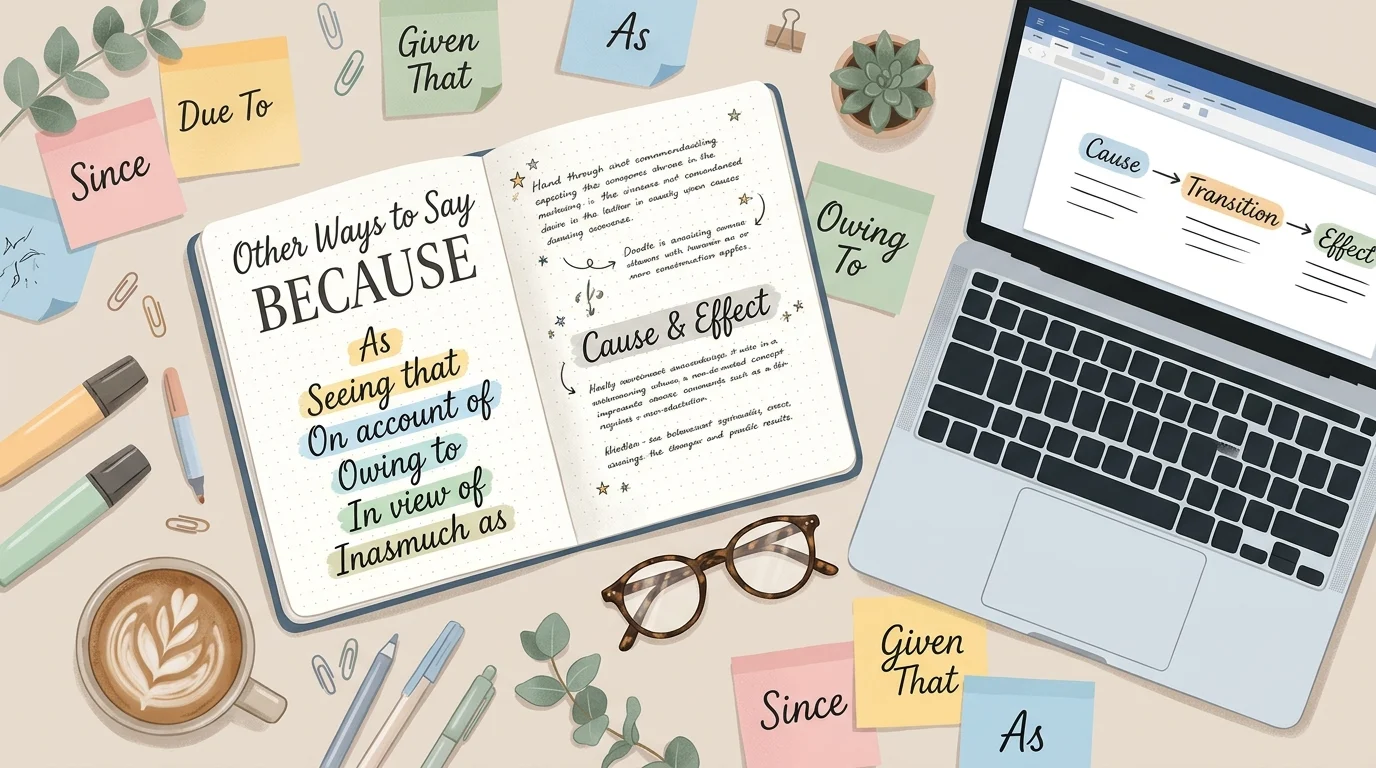
Quick Answer: Instead of saying “because,” you can use phrases like “since,” “as,” “due to,” “owing to,” “given that,” “on account of,” or “for the reason that” depending on whether you are writing an academic paper, a business email, or a casual message.
You are writing a message, an essay, or a report, and you need to explain a reason. The word “because” sits in your draft, but you have used it three times in one paragraph, and it feels repetitive. You want something fresher that still sounds natural and appropriate.
The word means introducing a reason or cause for something. People use it in writing, presentations, conversations, and everyday messages to explain why something happens. It is functional, safe, and widely understood.
Learning alternatives to “because” helps you avoid repetition and match your tone to the audience. An academic paper needs different language than a text to a friend. This is a core writing skill, not just vocabulary building.
With years of experience writing essays, business reports, and casual content, I have seen how small word choices change the rhythm and clarity of writing. The right words explain reasons smoothly, add precision, or keep things simple. You can choose from formal alternatives and informal expressions in English.
Quick Categories
Formal Alternatives to “Because”
- Since
- As
- Due to
Pro Tip: Use these when writing academic papers, reports, or formal business documents.
Casual Alternatives
- Cause
- ‘Cause
- Seeing as
Pro Tip: Save these for conversations, texts, or relaxed blog posts.
Professional Alternatives
- Owing to
- Given that
- On account of
Pro Tip: These work for business emails, presentations, or client-facing documents.
Informal Expressions
- Being that
- For the simple reason that
- In light of the fact that
Pro Tip: Use informal expressions only in relaxed chats, not in formal academic writing.
Common Mistakes
- Incorrect: “Because of I was tired…”
Correct: “Because I was tired…” - Incorrect: “Because why…”
Correct: “Because…” or “The reason is…” - Incorrect: Using “because” with “so” in the same sentence.
Correct: Use one, not both: “Because it rained, we stayed in” OR “It rained, so we stayed in.” - Incorrect: “Because of the fact that…”
Correct: “Because…” or “Since…” - Incorrect: Starting a sentence with “Because” in very formal writing without care.
Correct: Use “Since” or “As” for a smoother formal start.
What Does “Because” Mean?
It is a conjunction used to introduce a reason or cause for something. Grammatically, “because” connects a dependent clause (the reason) to a main clause (the result).
Example: “We cancelled the picnic because it was raining.”
When to Use “Because”
- In academic essays and research papers
- In business reports and emails
- In casual conversations and texts
- In blog posts and articles
- In presentations and speeches
Spoken vs Written: Common in both, especially in spoken and informal written contexts.
Formal vs Informal: Generally neutral. Can feel repetitive in formal writing without alternatives.
Is It Polite and Professional to Say “Because”?
Yes, it is polite. It is also professional in most writing and speaking contexts. The word is neutral, clear, and rarely inappropriate. However, in very formal writing, it can feel repetitive or slightly casual when overused.
Politeness means showing clarity and consideration. Professionalism means matching your audience and purpose.
Business style example: “We are delaying the launch because the final testing phase revealed a minor issue.”
Verdict: Polite? Yes. Professional? Yes, in most contexts. Use alternatives to avoid repetition.
Pros and Cons of Using “Because”
Pros:
- Universally understood and clear
- Directly explains reasons
- Short and easy to include in writing
- Works across many contexts
Cons:
- Overused and can feel repetitive
- Can sound simple or casual in formal writing
- May feel abrupt without variety
- Lacks sophistication without alternatives
Other Ways to Say “Because” (With Examples)
These alternatives will help you sound more fluent, confident, and natural in different situations. Use them according to tone, context, and audience.
Formal Alternatives
- Phrase: Since
Meaning: Introduce a reason or cause.
Explanation: Formal and smooth; often used at the start of a sentence.
Example Sentence: “Since the deadline is approaching, we need to finalize the plan.”
Best Use: Academic writing
Worst Use: Very casual texts
Tone: Formal, neutral, smooth
Context Variability:- Casual: “Since you are here, help me out.”
- Professional: “Since sales are up, we can expand.”
- Spoken: “Since it is raining, take an umbrella.”
- Phrase: As
Meaning: Introduce a reason.
Explanation: Formal and concise.
Example Sentence: “As the data shows, customer demand is rising.”
Best Use: Essays, reports
Worst Use: Quick chats
Tone: Formal, concise, clear
Context Variability:- Casual: “As you know, it is important.”
- Professional: “As requested, here is the report.”
- Spoken: “As I said, we should wait.”
- Phrase: Due to
Meaning: Because of a specific cause.
Explanation: Formal and precise.
Example Sentence: “The flight was delayed due to bad weather.”
Best Use: News writing, reports
Worst Use: Casual conversations
Tone: Formal, precise, direct
Context Variability:- Casual: N/A
- Professional: “Due to budget cuts, the project is on hold.”
- Spoken: “Due to traffic, I am late.”
- Phrase: Owing to
Meaning: Because of a specific cause.
Explanation: Formal and slightly more elaborate.
Example Sentence: “Owing to the pandemic, many events moved online.”
Best Use: Formal presentations
Worst Use: Social media
Tone: Formal, explanatory, polished
Context Variability:- Casual: N/A
- Professional: “Owing to strong demand, we are hiring.”
- Spoken: N/A
Professional Alternatives
- Phrase: Given that
Meaning: Considering a reason or fact.
Explanation: Neutral and workplace-friendly.
Example Sentence: “Given that the client approved the design, we can proceed.”
Best Use: Business emails
Worst Use: Creative writing
Tone: Professional, neutral, clear
Context Variability:- Casual: “Given that it is late, let us stop.”
- Professional: “Given that costs are high, we need approval.”
- Spoken: “Given that we are early, let us grab coffee.”
- Phrase: On account of
Meaning: Because of a specific reason.
Explanation: Friendly and professional.
Example Sentence: “On account of the merger, several roles will change.”
Best Use: Client emails
Worst Use: Academic papers
Tone: Professional, formal, helpful
Context Variability:- Casual: N/A
- Professional: “On account of the holiday, the office is closed.”
- Spoken: “On account of the rain, the game was cancelled.”
- Phrase: In light of the fact that
Meaning: Because of a known fact.
Explanation: Professional and emphatic.
Example Sentence: “In light of the fact that sales are down, we need a new strategy.”
Best Use: Business reports
Worst Use: Casual texts
Tone: Professional, emphatic, clear
Context Variability:- Casual: N/A
- Professional: “In light of the fact that resources are limited, we must prioritize.”
- Spoken: N/A
- Phrase: For the reason that
Meaning: Because of a specific reason.
Explanation: Direct and formal.
Example Sentence: “The policy was updated for the reason that new regulations were introduced.”
Best Use: Formal reports
Worst Use: Casual emails
Tone: Formal, direct, clear
Context Variability:- Casual: N/A
- Professional: “For the reason that costs increased, we adjusted the budget.”
- Spoken: N/A
Casual Alternatives
- Phrase: Cause
Meaning: Because (informal).
Explanation: Very casual and common in speech.
Example Sentence: “I stayed home cause I was not feeling well.”
Best Use: Conversations, texts
Worst Use: Formal writing
Tone: Casual, relaxed, informal
Context Variability:- Casual: “Cause I said so.”
- Professional: N/A
- Spoken: “Cause it is fun.”
- Phrase: ‘Cause
Meaning: Because (shortened).
Explanation: Casual and conversational.
Example Sentence: “I love this place ’cause the food is amazing.”
Best Use: Spoken English
Worst Use: Business emails
Tone: Casual, conversational, friendly
Context Variability:- Casual: “‘Cause why not?”
- Professional: N/A
- Spoken: “‘Cause I want to.”
- Phrase: Seeing as
Meaning: Since or because.
Explanation: Casual but clear.
Example Sentence: “Seeing as we are all here, let us start the meeting.”
Best Use: Team chats
Worst Use: Legal writing
Tone: Casual, clear, friendly
Context Variability:- Casual: “Seeing as it is Friday, let us celebrate.”
- Professional: N/A
- Spoken: “Seeing as you asked, I will explain.”
- Phrase: Being that
Meaning: Since or because.
Explanation: Casual and informal.
Example Sentence: “Being that it is your birthday, dessert is on me.”
Best Use: Conversations
Worst Use: Academic papers
Tone: Casual, friendly, light
Context Variability:- Casual: “Being that we are early, let us wait.”
- Professional: N/A
- Spoken: “Being that it is hot, let us swim.”
Friendly and Warm Alternatives
- Phrase: In view of
Meaning: Considering a reason or fact.
Explanation: Warm and common in both speech and writing.
Example Sentence: “In view of your hard work, you deserve a break.”
Best Use: General writing
Worst Use: Formal legal documents
Tone: Friendly, neutral, clear
Context Variability:- Casual: “In view of the weather, let us stay in.”
- Professional: “In view of recent changes, we updated the plan.”
- Spoken: “In view of what happened, be careful.”
- Phrase: Considering that
Meaning: Taking a fact into account.
Explanation: Engaging and warm.
Example Sentence: “Considering that you just started, you are doing great.”
Best Use: Encouraging messages
Worst Use: Technical reports
Tone: Warm, engaging, supportive
Context Variability:- Casual: “Considering that it is late, let us go.”
- Professional: “Considering that the results are positive, we proceed.”
- Spoken: “Considering that you tried, that is enough.”
- Phrase: For
Meaning: Because (literary or formal).
Explanation: Simple and slightly literary.
Example Sentence: “She smiled, for she knew the answer.”
Best Use: Narrative writing
Worst Use: Casual texts
Tone: Literary, formal, warm
Context Variability:- Casual: N/A
- Professional: N/A
- Spoken: N/A
- Phrase: Now that
Meaning: Because something has happened.
Explanation: Personal and helpful.
Example Sentence: “Now that the project is done, we can relax.”
Best Use: Explanations
Worst Use: Short texts
Tone: Warm, helpful, clear
Context Variability:- Casual: “Now that you mention it, I agree.”
- Professional: “Now that the contract is signed, we begin.”
- Spoken: “Now that it stopped raining, let us go.”
Informal and Humorous Alternatives
- Phrase: Inasmuch as
Meaning: Because or to the extent that.
Explanation: Very formal, sometimes humorous when overused.
Example Sentence: “Inasmuch as we agree, let us move forward.”
Best Use: Legal or formal writing
Worst Use: Casual conversations
Tone: Formal, legal, stiff
Context Variability:- Casual: N/A
- Professional: “Inasmuch as the terms are met, we approve.”
- Spoken: N/A
- Phrase: By reason of
Meaning: Because of a specific cause.
Explanation: Formal and slightly old-fashioned.
Example Sentence: “By reason of his experience, he was chosen for the role.”
Best Use: Formal documents
Worst Use: Social posts
Tone: Formal, traditional, precise
Context Variability:- Casual: N/A
- Professional: “By reason of the delay, penalties apply.”
- Spoken: N/A
- Phrase: For the simple reason that
Meaning: Because of an obvious reason.
Explanation: Direct and emphatic.
Example Sentence: “I trust her for the simple reason that she has never lied.”
Best Use: Persuasive writing
Worst Use: Formal contexts
Tone: Direct, confident, clear
Context Variability:- Casual: “For the simple reason that it works.”
- Professional: N/A
- Spoken: “For the simple reason that I said so.”
- Phrase: Just because
Meaning: For no particular reason or simply because.
Explanation: Casual and playful.
Example Sentence: “I bought it just because I liked it.”
Best Use: Conversations
Worst Use: Academic writing
Tone: Casual, playful, light
Context Variability:- Casual: “Just because.”
- Professional: N/A
- Spoken: “Just because I can.”
Celebratory Alternatives
- Phrase: Thanks to
Meaning: Because of a positive cause.
Explanation: Warm and grateful.
Example Sentence: “Thanks to your help, we finished early.”
Best Use: Grateful messages
Worst Use: Negative contexts
Tone: Warm, positive, grateful
Context Variability:- Casual: “Thanks to you, it worked.”
- Professional: “Thanks to the team, we exceeded targets.”
- Spoken: “Thanks to the weather, it was perfect.”
- Phrase: On the strength of
Meaning: Because of a strong reason or support.
Explanation: Emphatic and positive.
Example Sentence: “On the strength of the new evidence, the case was reopened.”
Best Use: Persuasive writing
Worst Use: Casual texts
Tone: Confident, positive, formal
Context Variability:- Casual: N/A
- Professional: “On the strength of our results, we expanded.”
- Spoken: N/A
- Phrase: In response to
Meaning: Because of or as a reaction to something.
Explanation: Warm and professional.
Example Sentence: “In response to customer feedback, we improved the app.”
Best Use: Business updates
Worst Use: Casual texts
Tone: Professional, responsive, positive
Context Variability:- Casual: N/A
- Professional: “In response to demand, we launched a new line.”
- Spoken: “In response to your question, yes.”
- Phrase: As a result of
Meaning: Because of a cause and its result.
Explanation: Neutral and clear.
Example Sentence: “As a result of the campaign, sales increased by 20%.”
Best Use: Reports, presentations
Worst Use: Casual conversations
Tone: Neutral, clear, professional
Context Variability:- Casual: N/A
- Professional: “As a result of the merger, jobs were created.”
- Spoken: “As a result of the rain, the match was cancelled.”
Social Media Style Alternatives
- Phrase: Cause why
Meaning: Because (slang).
Explanation: Fun and trendy.
Example Sentence: “I am excited cause why? Vacation!”
Best Use: Social media
Worst Use: Formal emails
Tone: Trendy, fun, casual
Context Variability:- Casual: “Cause why not?”
- Professional: N/A
- Spoken: “Cause why?”
- Phrase: The reason? Simple
Meaning: Introduce a simple reason.
Explanation: Trendy and dramatic.
Example Sentence: “The reason? Simple: it works.”
Best Use: Funny posts
Worst Use: Professional emails
Tone: Humorous, playful, casual
Context Variability:- Casual: “The reason? Simple: I like it.”
- Professional: N/A
- Spoken: “The reason? Simple.”
- Phrase: You can blame
Meaning: Playfully attribute a cause.
Explanation: Bold and casual.
Example Sentence: “You can blame the weather for my bad mood.”
Best Use: Social posts
Worst Use: Client emails
Tone: Bold, playful, casual
Context Variability:- Casual: “You can blame me.”
- Professional: N/A
- Spoken: “You can blame the traffic.”
- Phrase: So yeah, that is why
Meaning: Casually conclude a reason.
Explanation: Playful and trendy.
Example Sentence: “So yeah, that is why I am late.”
Best Use: Social posts
Worst Use: Formal reports- Tone: Playful, trendy, casual
Context Variability: - Casual: “So yeah, that is why.”
- Professional: N/A
- Spoken: “So yeah, that is why.”
- Tone: Playful, trendy, casual
- Phrase: Blame it on
Meaning: Attribute a cause playfully.
Explanation: Warm and social.
Example Sentence: “Blame it on the coffee, but I am wide awake.”
Best Use: Social messages
Worst Use: Formal emails
Tone: Warm, social, playful
Context Variability:- Casual: “Blame it on the rain.”
- Professional: N/A
- Spoken: “Blame it on me.”
Pull Quotes
“Because” is clear and safe, but safe can also mean forgettable. A fresh phrase shows you put thought into your writing.
Tone matters more than vocabulary. “‘Cause” in a research paper sounds careless. “Inasmuch as” in a text to a friend sounds stiff.
Good writing is not about big words. It is about choosing the right words for the right reader at the right moment.
Variety works in writing only when you know your audience. When in doubt, choose clarity over cleverness.
Mini Quiz
1. You are writing an academic essay. Which is most appropriate?
a) “‘Cause”
b) “Since”
c) “Cause why”
2. You are texting a close friend. What should you say?
a) “Inasmuch as”
b) “‘Cause”
c) “Owing to”
3. Which phrase is best for a business report?
a) “Given that”
b) “So yeah, that is why”
c) “Blame it on”
4. You are posting on social media. Which fits best?
a) “As a result of”
b) “Cause why”
c) “In light of the fact that”
Answers:
- (b) – Formal and smooth for academic writing.
- (b) – Casual and natural for texting a friend.
- (a) – Professional and clear for business reports.
- (b) – Trendy and fun for social media.
Comparison Table
| Phrase | Tone | Best Use |
|---|---|---|
| Since | Formal, smooth | Academic writing |
| As | Formal, concise | Essays, reports |
| Due to | Formal, precise | News writing, reports |
| Owing to | Formal, polished | Formal presentations |
| Given that | Professional, neutral | Business emails |
| On account of | Professional, formal | Client emails |
| In light of the fact that | Professional, emphatic | Business reports |
| Cause / ‘Cause | Casual, relaxed | Conversations, texts |
| Seeing as | Casual, friendly | Team chats |
| Thanks to | Warm, grateful | Grateful messages |
| As a result of | Neutral, clear | Reports, presentations |
| Cause why | Trendy, fun | Social media |
FAQs
What can I say instead of “because”?
You can say “since,” “as,” “due to,” “owing to,” “given that,” “on account of,” or “for the reason that” depending on context.
Is “because” formal or informal?
It is neutral. It works in most writing and speaking contexts, but alternatives like “since” or “due to” sound more formal.
How do you say “because” professionally in an email?
Use “given that,” “due to,” or “as a result of.” These sound professional without being too stiff.
What does “given that” mean?
“Given that” means considering that or because of a known fact. It is often used in professional and analytical writing.
Is it okay to use “’cause” instead of “because”?
Yes, in casual conversation and informal writing. Avoid it in academic or formal business writing.
Conclusion
Learning alternatives to “because” helps you sound fresh, natural, and thoughtful in English. You can be formal, casual, funny, or warm depending on who reads your message. The right phrase makes your writing stand out.
Practice choosing phrases based on tone and context. Try one new expression each time you write and notice how your writing improves. Small changes build fluency over time.
Which phrase will you use next time? Share this article with a colleague who wants to write better.
See Also
- Other Ways to Say “According To”
- Other Ways to Say “For Example”
- Other Ways to Say “Get Well Soon”
- Professional English Greetings for Workplace Emails

Alexander Whitmore is a passionate writer and editor who specializes in English expressions, vocabulary, and effective communication. He helps readers discover clearer, more natural, and professional ways to express their thoughts.
1 thought on “40+ Other Ways to Say “Because” (Formal, Casual & Professional) 2026”