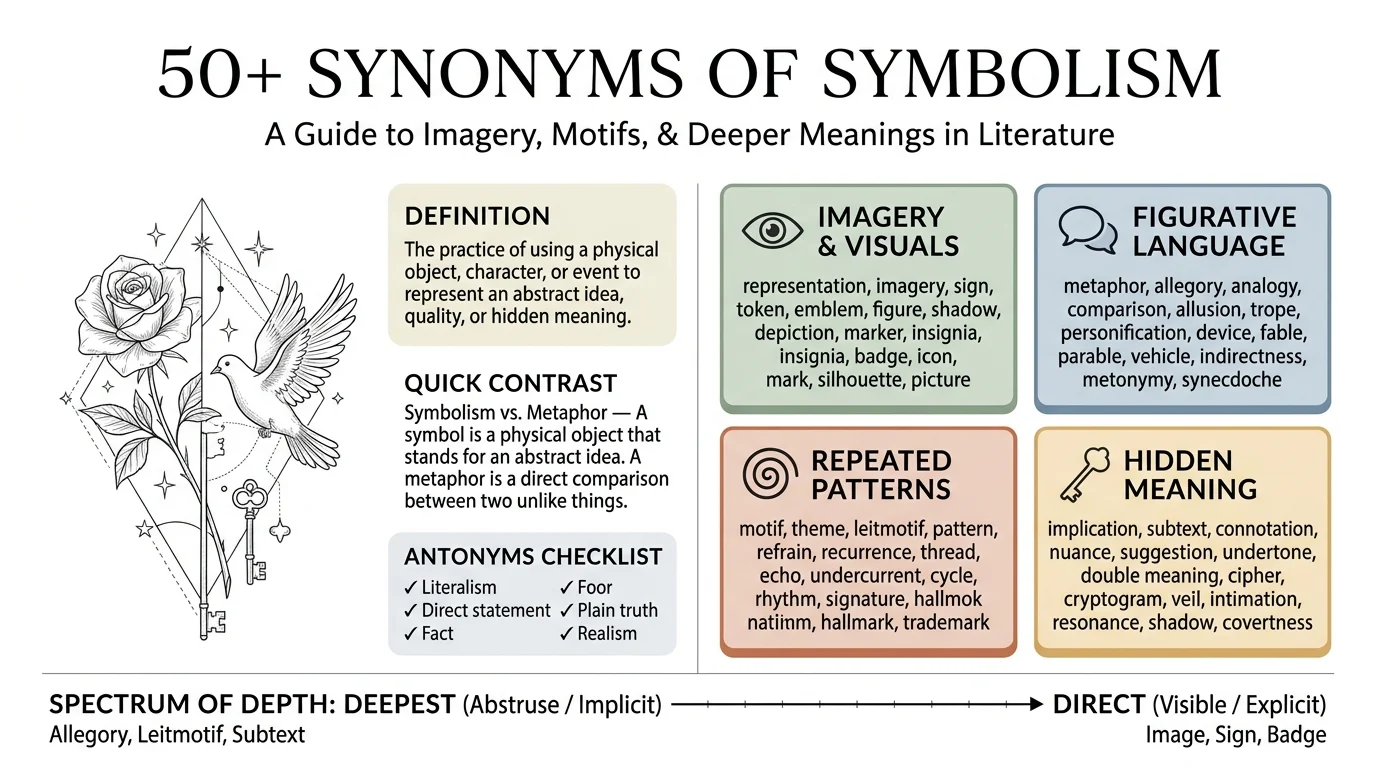
Quick Answer: Symbolism is the use of symbols to express ideas or feelings. Common alternatives include imagery, metaphor, allegory, and representation.
You are analyzing a novel for class and notice that a red rose keeps appearing in key scenes. Your teacher asks what the flower stands for, and you reach for the word symbolism. Moments like this show why a symbolism synonym can be useful. The term describes the practice of using objects, colors, or actions to carry deeper meaning beyond their literal sense. Writers, students, and speakers often need a fresh word because the same noun can feel heavy or repetitive. A well chosen alternative helps you capture the exact layer of meaning you want to discuss. This article presents fifty accurate options, each with a short meaning and two examples, plus a quiz and answers to common questions.
50 Synonyms for Symbolism
1. Imagery
Short Meaning: The use of vivid descriptions and pictures to convey ideas.
Example 1: The poet’s imagery of winter suggests loss and silence.
Example 2: Advertising often relies on strong imagery to sell a feeling.
2. Metaphor
Short Meaning: A comparison that describes one thing as another.
Example 1: The teacher used a metaphor to explain the internet as an ocean.
Example 2: Her novel builds a metaphor for grief through a locked house.
3. Allegory
Short Meaning: A story with a hidden moral or political meaning.
Example 1: The fable is an allegory about greed and its costs.
Example 2: The film works as an allegory for modern surveillance.
4. Representation
Short Meaning: The act of standing for or depicting something else.
Example 1: The dove is a common representation of peace.
Example 2: The mural offers a representation of the city’s diverse history.
5. Allusion
Short Meaning: An indirect reference to a well known person or event.
Example 1: The speech contains an allusion to the moon landing.
Example 2: His song title makes a clever allusion to a classic poem.
6. Signification
Short Meaning: The process of conveying meaning through signs.
Example 1: The study examined the signification of colors in flags.
Example 2: Body language has its own system of signification.
7. Figuration
Short Meaning: The use of figurative forms to express ideas.
Example 1: The sculpture’s figuration blends human and animal shapes.
Example 2: Religious art often depends on careful figuration.
8. Emblem
Short Meaning: A symbol that represents a group or idea.
Example 1: The eagle serves as an emblem of national pride.
Example 2: The school crest is an emblem of its long history.
9. Motif
Short Meaning: A recurring image or idea in a creative work.
Example 1: The motif of the river appears in every chapter.
Example 2: A repeated musical motif ties the scenes together.
10. Iconography
Short Meaning: The visual symbols used in art or culture.
Example 1: The cathedral’s iconography includes saints and angels.
Example 2: Film scholars study the iconography of the western genre.
11. Token
Short Meaning: A small object that stands for something larger.
Example 1: The ring was a token of their friendship.
Example 2: A white flag is a token of surrender.
12. Figure
Short Meaning: A shape or image that carries a deeper idea.
Example 1: The ghostly figure in the painting suggests fear.
Example 2: A mother figure often appears in his short stories.
13. Trope
Short Meaning: A common pattern or image used to convey meaning.
Example 1: The wise old mentor is a familiar trope in fantasy.
Example 2: The trope of the journey home shapes the whole plot.
14. Metaphorical Language
Short Meaning: Speech that uses comparisons rather than literal terms.
Example 1: His metaphorical language made the science lecture memorable.
Example 2: The essay uses metaphorical language to describe memory.
15. Poetic Device
Short Meaning: A technique writers use to create meaning and effect.
Example 1: The poet relies on a poetic device to suggest time passing.
Example 2: Each poetic device in the stanza adds emotional weight.
16. Figurative Meaning
Short Meaning: A meaning that goes beyond literal words.
Example 1: The phrase carries a figurative meaning about hope.
Example 2: Students learned to spot figurative meaning in slogans.
17. Hidden Meaning
Short Meaning: A message that is not stated directly.
Example 1: The fairy tale holds a hidden meaning about kindness.
Example 2: Reviewers found a hidden meaning in the final scene.
18. Deeper Meaning
Short Meaning: A significance that lies beneath the surface.
Example 1: The locked door has a deeper meaning for the hero.
Example 2: The ceremony carries a deeper meaning for the community.
19. Subtext
Short Meaning: An underlying message not stated openly.
Example 1: The dialogue has a subtext of jealousy.
Example 2: The manager’s praise carried a subtext of warning.
20. Connotation
Short Meaning: An idea or feeling a word suggests beyond its plain sense.
Example 1: The word home has a warm connotation for many readers.
Example 2: The brand chose a name with a positive connotation.
21. Visual Language
Short Meaning: The use of images and design to communicate ideas.
Example 1: The poster’s visual language suggests speed and power.
Example 2: Video games rely on visual language to guide players.
22. Visual Metaphor
Short Meaning: An image that stands for an abstract idea.
Example 1: The falling leaves form a visual metaphor for aging.
Example 2: The ad uses a visual metaphor of a maze for confusion.
23. Color Code
Short Meaning: The use of colors to carry fixed meanings.
Example 1: The map follows a color code for temperature.
Example 2: Hospital signs often use a color code for urgency.
24. Coded Meaning
Short Meaning: A meaning hidden in signs that insiders understand.
Example 1: The painting holds a coded meaning for its patrons.
Example 2: Protest songs often carry a coded meaning.
25. Typology
Short Meaning: A system of symbols that represent deeper truths.
Example 1: The scholar studied the typology of ancient seals.
Example 2: Religious typology links events across texts.
26. Semiotics
Short Meaning: The study of signs and how they create meaning.
Example 1: The course introduces semiotics through street signs.
Example 2: Semiotics helps designers understand brand logos.
27. Sign System
Short Meaning: A set of signs used to communicate meaning.
Example 1: Traffic lights form a simple sign system.
Example 2: The artist built a sign system from household objects.
28. Personification
Short Meaning: Giving human traits to an object or idea.
Example 1: The poem uses personification to make the wind speak.
Example 2: The cartoon relies on personification of animals.
29. Analogy
Short Meaning: A comparison that explains one thing through another.
Example 1: The doctor used an analogy to describe the immune system.
Example 2: Her analogy between gardens and teams clarified the idea.
30. Parable
Short Meaning: A short story that teaches a moral lesson.
Example 1: The parable of the lost sheep teaches forgiveness.
Example 2: The coach told a parable about patience.
31. Fable
Short Meaning: A brief tale with animals that carries a lesson.
Example 1: The fable of the tortoise warns against pride.
Example 2: The children acted out a fable about honesty.
32. Archetype
Short Meaning: A universal pattern or image found across cultures.
Example 1: The hero’s journey follows a classic archetype.
Example 2: The wise grandmother is an archetype in many tales.
33. Emblematic Image
Short Meaning: A picture that stands for a broader concept.
Example 1: The broken chain is an emblematic image of freedom.
Example 2: The director used an emblematic image of a rising sun.
34. Cultural Symbol
Short Meaning: An object with shared meaning in a society.
Example 1: The maple leaf is a cultural symbol of Canada.
Example 2: The dragon is a cultural symbol in many Asian nations.
35. Visual Cue
Short Meaning: A visual hint that signals meaning to viewers.
Example 1: The dim lighting acts as a visual cue for danger.
Example 2: The red button serves as a visual cue for stopping.
36. Thematic Image
Short Meaning: An image that carries a story’s central theme.
Example 1: The withering tree is a thematic image of decline.
Example 2: The open window forms a thematic image of escape.
37. Double Meaning
Short Meaning: A phrase or image with two interpretations.
Example 1: The title has a double meaning that surprises readers.
Example 2: The joke depends on a double meaning of one word.
38. Layered Meaning
Short Meaning: Several levels of significance within one image.
Example 1: The statue carries a layered meaning for historians.
Example 2: The final line has a layered meaning for careful readers.
39. Symbolic Gesture
Short Meaning: An action that stands for a larger idea.
Example 1: Planting a tree was a symbolic gesture of renewal.
Example 2: The handshake became a symbolic gesture of peace.
40. Symbolic Act
Short Meaning: A deed performed to express a deeper message.
Example 1: The team’s silence was a symbolic act of protest.
Example 2: Releasing doves is a symbolic act at the ceremony.
41. Figurative Art
Short Meaning: Art that represents things through recognizable forms.
Example 1: The gallery displays figurative art from the 1920s.
Example 2: Her figurative art often hints at political themes.
42. Symbolic Form
Short Meaning: A shape or pattern used to convey meaning.
Example 1: The circle appears as a symbolic form of unity.
Example 2: The artist used a symbolic form to suggest growth.
43. Narrative Symbol
Short Meaning: An object or detail that carries meaning in a story.
Example 1: The pocket watch serves as a narrative symbol of memory.
Example 2: The storm is a narrative symbol of conflict.
44. Visual Motif
Short Meaning: A repeated image that builds meaning over time.
Example 1: The mirror acts as a visual motif in the film.
Example 2: The artist’s visual motif of birds appears in every panel.
45. Interpretive Layer
Short Meaning: A level of meaning added through reading or viewing.
Example 1: The painting has an interpretive layer about class.
Example 2: The poem offers an interpretive layer about loss.
46. Coded Image
Short Meaning: A picture that hides a message for viewers.
Example 1: The coded image in the poster warned of danger.
Example 2: The tapestry contains a coded image known to nobles.
47. Conceptual Sign
Short Meaning: A sign that points to an abstract idea.
Example 1: The compass is a conceptual sign of direction in life.
Example 2: The broken mirror works as a conceptual sign of shattered hope.
48. Symbolic Reference
Short Meaning: A mention that points to a known meaning.
Example 1: The speech includes a symbolic reference to freedom.
Example 2: The logo has a symbolic reference to local mountains.
49. Thematic Motif
Short Meaning: A recurring element that expresses a central idea.
Example 1: The thematic motif of water runs through the novel.
Example 2: The director used a thematic motif of clocks and aging.
50. Visual Allegory
Short Meaning: An image that tells a story with hidden meaning.
Example 1: The mural is a visual allegory of justice.
Example 2: The advertisement reads as a visual allegory of teamwork.
Short Quiz
1: What does symbolism mean?
A. Using symbols to express ideas
B. Writing only factual reports
C. Speaking in a loud voice
D. Counting objects precisely
2: Which word best replaces symbolism in this sentence: “The novel uses symbolism to explore grief.”
A. Imagery
B. Grammar
C. Punctuation
D. Spelling
3: How does a metaphor differ from symbolism?
A. They mean exactly the same thing
B. A metaphor compares two things, symbolism uses objects to carry meaning
C. Symbolism is only used in poetry
D. A metaphor is always longer than symbolism
4: Which option sounds most formal in an essay?
A. Hidden trick
B. Secret stuff
C. Allegory
D. Cool vibe
5: A recurring image in a story that builds meaning is best called a:
A. Motif
B. Caption
C. Paragraph
D. Syllable
Quiz Answers
- A. Symbolism uses symbols to express ideas, feelings, or themes.
- A. Imagery is the closest option for describing how the novel conveys its theme.
- B. A metaphor compares two things, while symbolism uses objects or details to carry deeper meaning.
- C. Allegory is a formal term suited to academic essays.
- A. A motif is a recurring image or idea that builds meaning.
Frequently Asked Questions
1: What is the best synonym for symbolism?
Imagery works well as a general alternative because it covers the visual and figurative side of meaning.
2: What does symbolism mean in simple words?
Symbolism is the use of objects or images to stand for bigger ideas or feelings.
3: What is a formal alternative to symbolism?
Allegory is a formal choice, especially when a whole story carries hidden meaning.
4: Can symbolism apply to everyday life as well as art?
Yes, symbolism appears in logos, colors, gestures, and ceremonies, not only in books and paintings.
5: What is the opposite of symbolism?
Literalism is a common opposite because it focuses on exact, surface meaning only.
Conclusion
Picking the right word can sharpen the way you discuss meaning in art, writing, and daily life. The alternatives above range from imagery and metaphor to motif and allegory. Your best option depends on context, tone, and meaning, since a single image, a full story, and a repeated pattern each call for a different label. Slow down and match the word to the exact layer of significance you want to point out. Careful choices make your analysis clearer and more convincing. Keep this symbolism synonym list close the next time you write, and choose the term that fits your sentence best.

Alexander Whitmore is a passionate writer and editor who specializes in English expressions, vocabulary, and effective communication. He helps readers discover clearer, more natural, and professional ways to express their thoughts.