
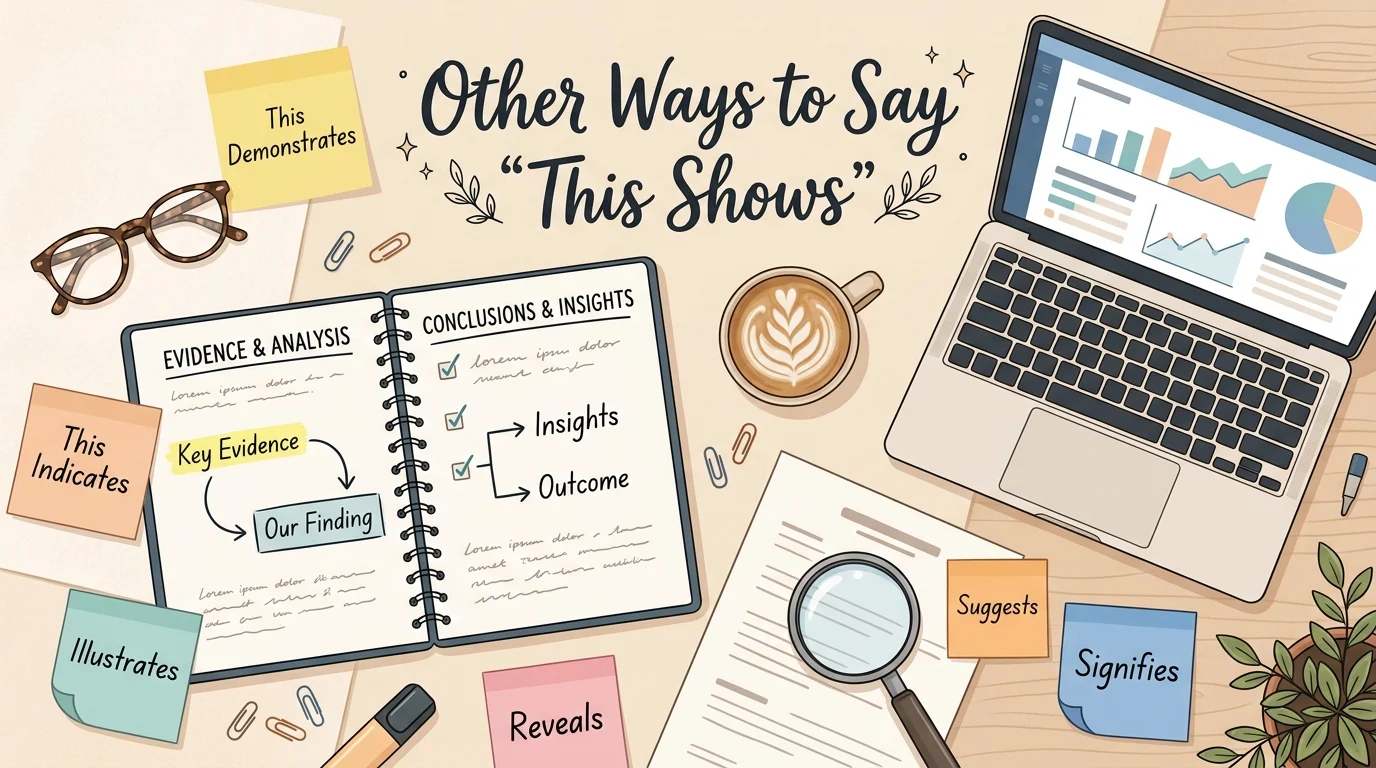
Quick Answer: Instead of saying “this shows,” you can use phrases like “this demonstrates,” “this indicates,” “this suggests,” “this reveals,” “this proves,” or “this highlights” depending on whether you are writing an academic paper, a business report, a presentation, or a casual message.
You are writing an essay, a report, or a presentation, and you want to explain what a piece of evidence means. The phrase “this shows” sits in your draft, but you have used it several times already, and it feels repetitive. You want something fresher that still sounds accurate and appropriate.
The phrase means pointing to evidence and explaining what it demonstrates, indicates, or proves. People use it in writing, presentations, research papers, and everyday messages to connect evidence with conclusions. It is functional, safe, and widely understood.
Learning alternatives to “this shows” helps you avoid repetition and match your tone to the audience. An academic paper needs different language than a text to a friend. This is a core analytical writing skill, not just vocabulary building.
With years of experience writing essays, research papers, business reports, and casual content, I have seen how small phrase choices change the clarity and strength of an argument. The right words guide the reader, add emphasis, or keep things simple. You can choose from formal alternatives and informal expressions in English.
Quick Categories
Formal Alternatives to “This Shows”
- This demonstrates
- This indicates
- This illustrates
Pro Tip: Use these when writing academic papers, research reports, or formal business documents.
Casual Alternatives
- So this means
- Which tells us
- That is why
Pro Tip: Save these for conversations, texts, or relaxed blog posts.
Professional Alternatives
- This suggests
- This reveals
- This confirms
Pro Tip: These work for business emails, presentations, or client-facing documents.
Informal Expressions
- Which goes to show
- So basically
- That says a lot
Pro Tip: Use informal expressions only in relaxed chats, not in formal academic writing.
Common Mistakes
- Incorrect: “This shows that how…”
Correct: “This shows how…” - Incorrect: “This shows about…”
Correct: “This shows that…” - Incorrect: Using “this shows” without explaining what it shows.
Correct: Always follow it with a clear conclusion or meaning. - Incorrect: “This shows the data is…”
Correct: “This shows that the data is…” - Incorrect: “This shows to us that…”
Correct: “This shows us that…”
What Does “This Shows” Mean?
It is a demonstrative phrase used to connect evidence with a conclusion, explaining what a fact, result, or observation demonstrates. Grammatically, “this” functions as a demonstrative pronoun referring to the preceding evidence, and “shows” acts as the verb linking it to a meaning.
Example: “Sales increased by 20% this quarter. This shows that the new marketing strategy is working.”
When to Use “This Shows”
- In academic essays and research papers
- In business reports and presentations
- In data analysis and interpretation
- In emails explaining findings
- In casual conversations drawing conclusions
Spoken vs Written: Common in both, especially in written and formal spoken contexts.
Formal vs Informal: Generally neutral to formal. Can feel stiff in very casual conversations.
Is It Polite and Professional to Say “This Shows”?
Yes, it is polite. It is also professional in most writing and speaking contexts. The phrase is neutral, clear, and rarely inappropriate. However, in very casual settings or creative writing, it can feel overly formal or repetitive.
Politeness means showing clarity and respect for evidence. Professionalism means matching your audience and purpose.
Business style example: “Customer complaints dropped by 30%. This shows that the new support system is effective.”
Verdict: Polite? Yes. Professional? Yes, in most contexts. Use alternatives to avoid repetition.
Pros and Cons of Using “This Shows”
Pros:
- Universally understood and clear
- Connects evidence to conclusions
- Short and easy to include in writing
- Works across many contexts
Cons:
- Overused and can feel repetitive
- Can sound robotic in creative writing
- May feel too simple in academic writing
- Lacks variety without alternatives
Other Ways to Say “This Shows” (With Examples)
These alternatives will help you sound more fluent, confident, and natural in different situations. Use them according to tone, context, and audience.
Formal Alternatives
- Phrase: This demonstrates
Meaning: Point to clear evidence of something.
Explanation: Formal and strong; suits academic and professional writing.
Example Sentence: “The experiment produced consistent results. This demonstrates the reliability of the method.”
Best Use: Academic writing
Worst Use: Casual texts
Tone: Formal, precise, confident
Context Variability:- Casual: N/A
- Professional: “This demonstrates our commitment to quality.”
- Spoken: “This demonstrates how the process works.”
- Phrase: This indicates
Meaning: Suggest or point to a likely conclusion.
Explanation: Formal and analytical.
Example Sentence: “There was a sharp rise in demand. This indicates growing customer interest.”
Best Use: Research reports
Worst Use: Quick chats
Tone: Formal, analytical, clear
Context Variability:- Casual: N/A
- Professional: “This indicates a need for more resources.”
- Spoken: “This indicates the trend is changing.”
- Phrase: This illustrates
Meaning: Make something clear through an example.
Explanation: Formal and explanatory.
Example Sentence: “The case study is compelling. This illustrates the importance of early intervention.”
Best Use: Essays, reports
Worst Use: Casual conversations
Tone: Formal, explanatory, clear
Context Variability:- Casual: N/A
- Professional: “This illustrates the value of teamwork.”
- Spoken: “This illustrates my point perfectly.”
- Phrase: This reveals
Meaning: Uncover or expose a hidden truth.
Explanation: Formal and insightful.
Example Sentence: “The survey results were surprising. This reveals a gap in communication.”
Best Use: Research and analysis
Worst Use: Creative writing
Tone: Formal, insightful, analytical
Context Variability:- Casual: N/A
- Professional: “This reveals a key weakness in the plan.”
- Spoken: “This reveals what really happened.”
Professional Alternatives
- Phrase: This suggests
Meaning: Propose a possible conclusion.
Explanation: Neutral and workplace-friendly.
Example Sentence: “The feedback was mostly positive. This suggests the product is well received.”
Best Use: Business emails
Worst Use: Creative writing
Tone: Professional, neutral, cautious
Context Variability:- Casual: “This suggests we should try again.”
- Professional: “This suggests a shift in customer behavior.”
- Spoken: “This suggests the plan might work.”
- Phrase: This confirms
Meaning: Verify or support a conclusion.
Explanation: Professional and confident.
Example Sentence: “The test results match our prediction. This confirms our hypothesis.”
Best Use: Reports, presentations
Worst Use: Casual texts
Tone: Professional, confident, clear
Context Variability:- Casual: N/A
- Professional: “This confirms the effectiveness of the strategy.”
- Spoken: “This confirms what I thought.”
- Phrase: This proves
Meaning: Establish a conclusion as true.
Explanation: Professional and emphatic.
Example Sentence: “The evidence is overwhelming. This proves the theory beyond doubt.”
Best Use: Persuasive writing
Worst Use: Tentative analysis
Tone: Professional, emphatic, confident
Context Variability:- Casual: “This proves I was right.”
- Professional: “This proves the need for change.”
- Spoken: “This proves it works.”
- Phrase: This highlights
Meaning: Draw attention to an important point.
Explanation: Professional and focused.
Example Sentence: “The incident was widely reported. This highlights the need for better safety measures.”
Best Use: Business reports
Worst Use: Text messages
Tone: Professional, focused, clear
Context Variability:- Casual: N/A
- Professional: “This highlights a key opportunity.”
- Spoken: “This highlights the problem.”
Casual Alternatives
- Phrase: So this means
Meaning: Explain the conclusion informally.
Explanation: Short and casual.
Example Sentence: “The store is empty. So this means everyone is at the beach.”
Best Use: Conversations, texts
Worst Use: Formal writing
Tone: Casual, direct, informal
Context Variability:- Casual: “So this means we are late.”
- Professional: N/A
- Spoken: “So this means it is free.”
- Phrase: Which tells us
Meaning: Draw a conclusion from evidence.
Explanation: Casual and conversational.
Example Sentence: “The reviews are glowing, which tells us the food is great.”
Best Use: Spoken English
Worst Use: Formal reports
Tone: Casual, conversational, friendly
Context Variability:- Casual: “Which tells us it is popular.”
- Professional: N/A
- Spoken: “Which tells us to wait.”
- Phrase: That is why
Meaning: Explain the reason behind something.
Explanation: Casual but clear.
Example Sentence: “The traffic was heavy. That is why we were late.”
Best Use: Conversations
Worst Use: Academic papers
Tone: Casual, clear, friendly
Context Variability:- Casual: “That is why I called.”
- Professional: N/A
- Spoken: “That is why it broke.”
- Phrase: That goes to show
Meaning: Point to a clear lesson or conclusion.
Explanation: Casual and informal.
Example Sentence: “He studied hard and passed. That goes to show hard work pays off.”
Best Use: Conversations
Worst Use: Formal writing
Tone: Casual, informal, friendly
Context Variability:- Casual: “That goes to show you never know.”
- Professional: N/A
- Spoken: “That goes to show it is possible.”
Friendly and Warm Alternatives
- Phrase: This tells us
Meaning: Draw an accessible conclusion.
Explanation: Warm and collaborative.
Example Sentence: “The numbers are up. This tells us the campaign is working.”
Best Use: Meetings, emails
Worst Use: Formal legal documents
Tone: Friendly, collaborative, clear
Context Variability:- Casual: “This tells us to keep going.”
- Professional: “This tells us the market is ready.”
- Spoken: “This tells us a lot.”
- Phrase: This points to
Meaning: Indicate a likely direction or conclusion.
Explanation: Engaging and warm.
Example Sentence: “The data is clear. This points to a strong comeback.”
Best Use: Storytelling, analysis
Worst Use: Technical reports
Tone: Warm, engaging, analytical
Context Variability:- Casual: “This points to a fun weekend.”
- Professional: “This points to a new opportunity.”
- Spoken: “This points to the answer.”
- Phrase: This means that
Meaning: Explain the direct implication.
Explanation: Simple and warm.
Example Sentence: “The deadline moved up. This means that we need to work faster.”
Best Use: Explanations
Worst Use: Short texts
Tone: Warm, simple, clear
Context Variability:- Casual: “This means that we can relax.”
- Professional: “This means that costs will rise.”
- Spoken: “This means that we are done.”
- Phrase: What this means is
Meaning: Clarify the meaning of evidence.
Explanation: Helpful and clear.
Example Sentence: “The policy changed. What this means is that everyone must reapply.”
Best Use: Educational content
Worst Use: Casual texts
Tone: Helpful, educational, warm
Context Variability:- Casual: “What this means is we are free.”
- Professional: “What this means is the plan works.”
- Spoken: “What this means is it is over.”
Informal and Humorous Alternatives
- Phrase: Which goes to show
Meaning: Point to a lesson or conclusion.
Explanation: Playful and informal.
Example Sentence: “He forgot his umbrella and got soaked, which goes to show you should always check the weather.”
Best Use: Casual writing
Worst Use: Formal reports
Tone: Informal, playful, wise
Context Variability:- Casual: “Which goes to show you never know.”
- Professional: N/A
- Spoken: “Which goes to show it happens.”
- Phrase: So basically
Meaning: Summarize the conclusion simply.
Explanation: Playful and casual.
Example Sentence: “The app crashed again. So basically, we need a new one.”
Best Use: Funny posts
Worst Use: Business emails
Tone: Humorous, casual, direct
Context Variability:- Casual: “So basically, it is a disaster.”
- Professional: N/A
- Spoken: “So basically, we are stuck.”
- Phrase: That says a lot
Meaning: Point to a meaningful implication.
Explanation: Casual and suggestive.
Example Sentence: “She helped without being asked. That says a lot about her character.”
Best Use: Conversational writing
Worst Use: Formal contexts
Tone: Casual, suggestive, warm
Context Variability:- Casual: “That says a lot about the place.”
- Professional: N/A
- Spoken: “That says a lot.”
- Phrase: Just goes to prove
Meaning: Point to a strong conclusion.
Explanation: Direct and informal.
Example Sentence: “They finished first again. Just goes to prove hard work wins.”
Best Use: Conversations
Worst Use: Academic writing
Tone: Informal, direct, engaging
Context Variability:- Casual: “Just goes to prove I was right.”
- Professional: N/A
- Spoken: “Just goes to prove it works.”
- Phrase: Tell me this does not show
Meaning: Playfully confirm a conclusion.
Explanation: Emphatic and casual.
Example Sentence: “The crowd went wild. Tell me this does not show the team is loved.”
Best Use: Blog posts
Worst Use: Legal documents
Tone: Informal, emphatic, playful
Context Variability:- Casual: “Tell me this does not show it is popular.”
- Professional: N/A
- Spoken: “Tell me this does not show I am right.”
Celebratory Alternatives
- Phrase: This is proof that
Meaning: Highlight a positive confirmation.
Explanation: Warm and inspirational.
Example Sentence: “The community raised funds in days. This is proof that people care.”
Best Use: Inspirational writing
Worst Use: Neutral reports
Tone: Warm, positive, uplifting
Context Variability:- Casual: “This is proof that it works.”
- Professional: “This is proof that our strategy is sound.”
- Spoken: “This is proof that she is talented.”
- Phrase: This is a clear sign that
Meaning: Point to a strong indicator.
Explanation: Emphatic and celebratory.
Example Sentence: “The team is smiling again. This is a clear sign that morale is back.”
Best Use: Speeches, tributes
Worst Use: Technical writing
Tone: Celebratory, warm, emphatic
Context Variability:- Casual: N/A
- Professional: “This is a clear sign that growth is returning.”
- Spoken: “This is a clear sign that it is working.”
- Phrase: This speaks volumes about
Meaning: Highlight a meaningful implication.
Explanation: Warm and confident.
Example Sentence: “The way they handled the crisis speaks volumes about their leadership.”
Best Use: Presentations
Worst Use: Casual texts
Tone: Warm, confident, positive
Context Variability:- Casual: N/A
- Professional: “This speaks volumes about our culture.”
- Spoken: “This speaks volumes about them.”
- Phrase: This stands as evidence that
Meaning: Use strong evidence to support a claim.
Explanation: Celebratory and motivating.
Example Sentence: “The record-breaking turnout stands as evidence that the campaign resonated.”
Best Use: Motivational content
Worst Use: Neutral reports
Tone: Celebratory, motivational, warm
Context Variability:- Casual: N/A
- Professional: “This stands as evidence that change is possible.”
- Spoken: “This stands as evidence that it works.”
Social Media Style Alternatives
- Phrase: So yeah, this shows
Meaning: Emphasize a conclusion casually.
Explanation: Short and trendy.
Example Sentence: “The comments are all positive. So yeah, this shows people love it.”
Best Use: Social media
Worst Use: Formal emails
Tone: Trendy, fun, casual
Context Variability:- Casual: “So yeah, this shows it is great.”
- Professional: N/A
- Spoken: “So yeah, this shows it is real.”
- Phrase: Proof right here
Meaning: Point to clear evidence playfully.
Explanation: Trendy and dramatic.
Example Sentence: “Proof right here: the before-and-after photos.”
Best Use: Funny posts
Worst Use: Professional emails
Tone: Humorous, playful, casual
Context Variability:- Casual: “Proof right here, look at this.”
- Professional: N/A
- Spoken: “Proof right here.”
- Phrase: And that right there shows
Meaning: Emphasize a visible conclusion.
Explanation: Bold and casual.
Example Sentence: “And that right there shows why practice matters.”
Best Use: Social posts
Worst Use: Client emails
Tone: Bold, playful, casual
Context Variability:- Casual: “And that right there shows it works.”
- Professional: N/A
- Spoken: “And that right there shows why.”
- Phrase: This says it all
Meaning: Point to something that needs no explanation.
Explanation: Playful and trendy.
Example Sentence: “The photo of the empty shelves says it all.”
Best Use: Social posts
Worst Use: Formal reports
Tone: Playful, trendy, casual
Context Variability:- Casual: “This says it all.”
- Professional: N/A
- Spoken: “This says it all.”
- Phrase: Take from this what you will
Meaning: Let the audience draw their own conclusion.
Explanation: Warm and social.
Example Sentence: “The numbers dropped after the change. Take from this what you will.”
Best Use: Social messages
Worst Use: Formal emails
Tone: Warm, social, suggestive
Context Variability:- Casual: “Take from this what you will.”
- Professional: N/A
- Spoken: “Take from this what you will.”
Pull Quotes
“This shows” is clear and safe, but safe can also mean forgettable. A fresh phrase shows you put thought into your argument.
Tone matters more than vocabulary. “Basically” in a research paper sounds careless. “This demonstrates” in a text to a friend sounds stiff.
Good writing is not about big words. It is about choosing the right words for the right reader at the right moment.
Emphasis works in writing only when you know your audience. When in doubt, choose clarity over cleverness.
Mini Quiz
1. You are writing an academic essay. Which is most appropriate?
a) “Basically”
b) “This demonstrates”
c) “This says it all”
2. You are texting a close friend. What should you say?
a) “This indicates”
b) “So this means”
c) “This confirms”
3. Which phrase is best for a business report?
a) “This suggests”
b) “Proof right here”
c) “So yeah, this shows”
4. You are posting on social media. Which fits best?
a) “This illustrates”
b) “This says it all”
c) “This reveals”
Answers:
- (b) – Formal and strong for academic writing.
- (b) – Casual and natural for texting a friend.
- (a) – Professional and cautious for business reports.
- (b) – Trendy and fun for social media.
Comparison Table
| Phrase | Tone | Best Use |
|---|---|---|
| This demonstrates | Formal, precise | Academic writing |
| This indicates | Formal, analytical | Research reports |
| This illustrates | Formal, explanatory | Essays, reports |
| This reveals | Formal, insightful | Research and analysis |
| This suggests | Professional, cautious | Business emails |
| This confirms | Professional, confident | Reports, presentations |
| This proves | Professional, emphatic | Persuasive writing |
| This highlights | Professional, focused | Business reports |
| So this means | Casual, direct | Conversations, texts |
| Which tells us | Casual, conversational | Spoken English |
| That goes to show | Informal, playful | Casual writing |
| This says it all | Playful, trendy | Social posts |
FAQs
What can I say instead of “this shows”?
You can say “this demonstrates,” “this indicates,” “this suggests,” “this reveals,” “this proves,” or “this highlights” depending on context.
Is “this shows” formal or informal?
It is neutral. It works in most writing and speaking contexts, but alternatives like “this demonstrates” or “this illustrates” sound more formal.
How do you say “this shows” professionally in a report?
Use “this indicates,” “this confirms,” or “this highlights.” These sound professional and precise.
What does “this suggests” mean?
“This suggests” means the evidence points to a possible conclusion, but it is not fully proven. It is often used in cautious, analytical writing.
Is it okay to use “which goes to show” instead of “this shows”?
Yes, in casual conversation and informal writing. Avoid it in academic or formal business writing.
Conclusion
Learning alternatives to “this shows” helps you sound fresh, natural, and thoughtful in English. You can be formal, casual, funny, or warm depending on who reads your message. The right phrase makes your writing stand out.
Practice choosing phrases based on tone and context. Try one new expression each time you write and notice how your writing improves. Small changes build fluency over time.
Which phrase will you use next time? Share this article with a colleague who wants to write better.
See Also
- Other Ways to Say “According To”
- Other Ways to Say “For Example”
- Other Ways to Say “Get Well Soon”
- Other Ways to Say “Happy Friday”

Charlotte Sinclair focuses on English language, word choice, and everyday expressions. She enjoys helping readers find the right words for different situations, making their writing more engaging, polished, and easy to understand.
3 thoughts on “40+ Other Ways to Say “This Shows” (Formal, Casual & Professional) 2026”