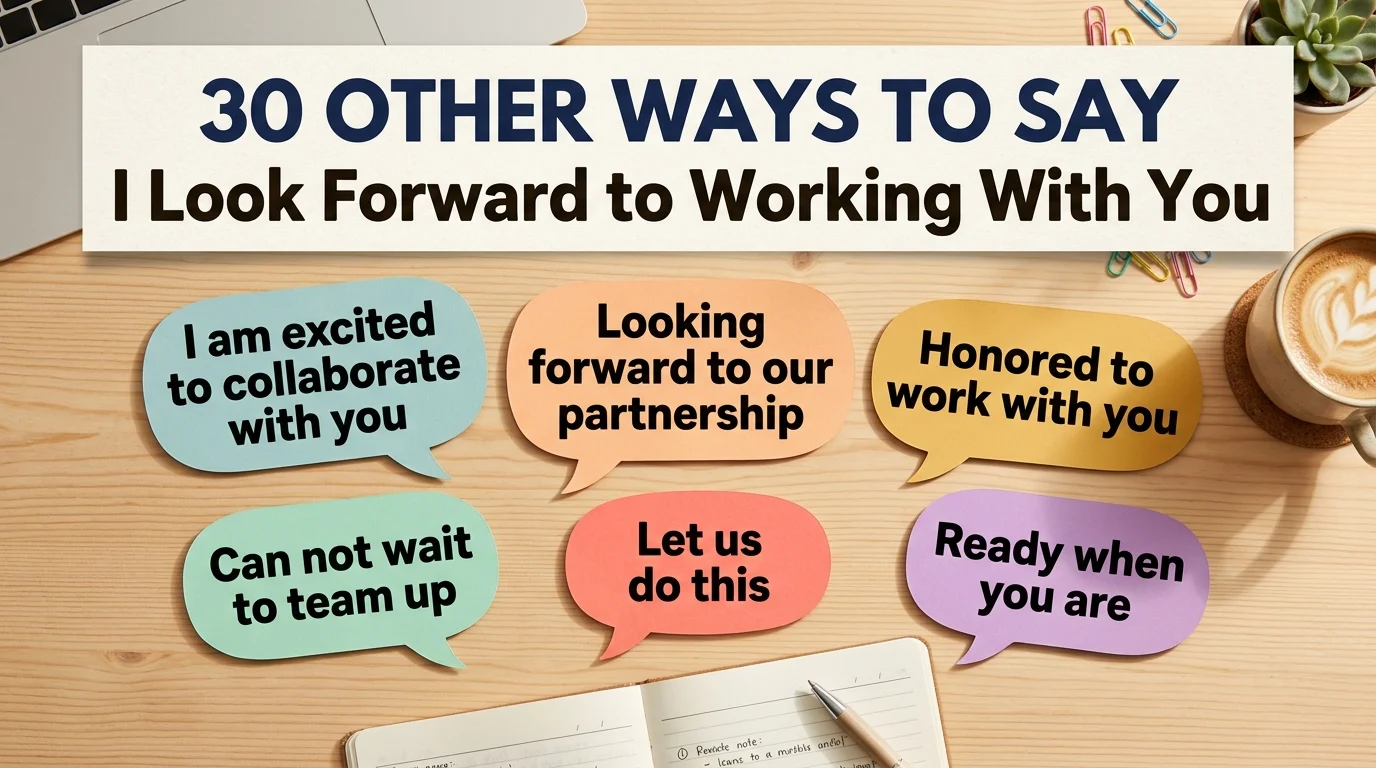
Quick Answer: “I look forward to working with you” is a polite, professional closing used in emails and business messages. Top alternatives include: I am excited to collaborate, looking forward to teaming up, eager to work together, I anticipate our partnership, and happy to be working with you.
Do you end every professional email with “I look forward to working with you”? You are not alone. This phrase is one of the most common closings in business English. But when you use it in every message, it loses impact and makes your writing feel generic.
The phrase “I look forward to working with you” expresses polite anticipation before a project, meeting, or partnership begins. Learning other ways to say I look forward to working with you helps you sound more genuine, more confident, and more memorable. Whether you want to express excitement in English about a new collaboration or need professional reaction phrases for formal correspondence, variety matters.
This guide gives you 30 fresh alternatives for every situation. You will learn formal alternatives, casual expressions, and professional options that fit any context. By the end, you will know exactly which phrase to use and when.
Quick Categories
Formal Alternatives to “I Look Forward to Working With You”
These work best in cover letters, official proposals, and formal business correspondence.
- I anticipate our collaboration with great enthusiasm
Meaning: I am eagerly waiting to work together
Example: Thank you for this opportunity. I anticipate our collaboration with great enthusiasm. - I await the opportunity to collaborate with you
Meaning: I am ready and waiting to work together
Example: Your proposal is excellent. I await the opportunity to collaborate with you. - I am eager to begin our professional partnership
Meaning: I am excited to start working together
Example: The contract is signed. I am eager to begin our professional partnership. - It is my pleasure to be working alongside you
Meaning: I feel honored to work with you
Example: It is my pleasure to be working alongside you on this project.
Pro Tip Box: Formal alternatives work best in cover letters and first-time correspondence. Avoid using them in quick follow-up emails.
Casual Alternatives to “I Look Forward to Working With You”
Perfect for colleagues you know well or informal workplace messages.
- Can not wait to team up
Meaning: I am very excited to work together
Example: This project sounds fun. Can not wait to team up. - Looking forward to it
Meaning: I am anticipating this positively
Example: Great meeting today. Looking forward to it. - Excited to get started with you
Meaning: I am eager to begin
Example: Thanks for including me. Excited to get started with you. - Happy to be on board
Meaning: I am glad to join
Example: Thanks for the invite. Happy to be on board.
Pro Tip Box: Casual alternatives work well with teammates you already know. Avoid them with new clients or senior executives.
Professional Alternatives to “I Look Forward to Working With You”
Ideal for emails, meetings, and workplace communication.
- I am excited to collaborate with you
Meaning: I am enthusiastic about working together
Example: Your team is impressive. I am excited to collaborate with you. - Looking forward to our partnership
Meaning: I anticipate a positive working relationship
Example: The terms look great. Looking forward to our partnership. - I value the chance to work together
Meaning: I appreciate this opportunity
Example: Thank you for reaching out. I value the chance to work together. - Eager to contribute to this project with you
Meaning: I am ready to add value together
Example: The goals are clear. Eager to contribute to this project with you.
Pro Tip Box: Professional alternatives are safe for almost any workplace email. They balance warmth with respect.
Informal Expressions
Use these with friends, close colleagues, or relaxed settings.
- Let us do this
Meaning: I am ready to start
Example: The plan is set. Let us do this. - Count me in
Meaning: I want to be part of it
Example: Sounds like a great idea. Count me in. - I am in
Meaning: I agree to participate
Example: You need help? I am in. - Ready when you are
Meaning: I am prepared to begin
Example: Just say the word. Ready when you are.
Pro Tip Box: These expressions add energy to your speech but avoid them in formal documents or with new clients.
Common Mistakes
- Using “I look forward to working with you” in every email
Example: I look forward to working with you. (sent to the same person five times)
Fix: Vary your closing lines. - Writing “I look forward to work with you”
Example: I look forward to work with you.
Fix: Use the gerund: I look forward to working with you. - Using it before any work has been discussed
Example: I look forward to working with you. (sent to a cold contact)
Fix: Use it only when a collaboration is likely or confirmed. - Making it too casual in a formal email
Example: Can not wait to work with you! (in a legal proposal)
Fix: Match the tone to the context. - Forgetting to add a specific detail
Example: I look forward to working with you.
Fix: Add context: I look forward to working with you on the marketing launch.
What Does “I Look Forward to Working With You” Mean?
Definition: This phrase expresses polite anticipation and positive expectation about a future collaboration.
Grammar: “Look forward to” is followed by a noun or gerund (verb + ing). Never use the base verb after “to” in this phrase.
Example: I look forward to working with you on this project.
When to Use “I Look Forward to Working With You”
- At the end of a job application or cover letter
- After accepting a new role or project
- In emails to new clients or partners
- After a successful meeting or interview
- When confirming a long-term collaboration
Spoken vs Written: More common in writing. In speech, “looking forward to working with you” sounds more natural.
Formal vs Informal: Formal and professional. Avoid in casual messages.
Is It Professional or Polite to Say “I Look Forward to Working With You”?
Politeness: Yes, it is very polite and respectful.
Professionalism: Yes, it is highly professional. It is one of the safest closings in business English.
Business Example: Thank you for the detailed proposal. I look forward to working with you on the next phase.
Polite? Yes
Professional? Yes, in almost all business contexts
Pros and Cons of Using “I Look Forward to Working With You”
Pros:
- Polite and respectful
- Professional and safe
- Widely understood
- Sets a positive tone
Cons:
- Overused in business emails
- Sounds generic
- Can feel insincere if repeated
- Lacks personality
Other Ways to Say “I Look Forward to Working With You” (With Examples)
These alternatives will help you sound more fluent, confident, and natural in different situations. Use them according to tone, context, and audience to express enthusiasm, professionalism, or warmth.
- Phrase: I am excited to collaborate with you
Meaning: I feel enthusiastic about working together
Explanation: A warm and professional alternative
Example Sentence: Your vision is inspiring. I am excited to collaborate with you.
Best Use: New partnerships
Worst Use: Cold emails
Tone: Warm, professional, positive
Context Variability: Professional and written - Phrase: Looking forward to our partnership
Meaning: I anticipate a positive working relationship
Explanation: Short and professional
Example Sentence: The terms are agreed. Looking forward to our partnership.
Best Use: Business emails
Worst Use: Casual chats
Tone: Professional, concise, warm
Context Variability: Professional and written - Phrase: I anticipate our collaboration with great enthusiasm
Meaning: I am eagerly waiting to work together
Explanation: Very formal and expressive
Example Sentence: Thank you for this opportunity. I anticipate our collaboration with great enthusiasm.
Best Use: Formal proposals
Worst Use: Quick replies
Tone: Formal, enthusiastic, polished
Context Variability: Professional and written - Phrase: I await the opportunity to collaborate with you
Meaning: I am ready and waiting to work together
Explanation: Formal and respectful
Example Sentence: Your proposal is excellent. I await the opportunity to collaborate with you.
Best Use: Official correspondence
Worst Use: Casual messages
Tone: Formal, respectful, serious
Context Variability: Professional and written - Phrase: I am eager to begin our professional partnership
Meaning: I am excited to start working together
Explanation: Shows strong enthusiasm
Example Sentence: The contract is signed. I am eager to begin our professional partnership.
Best Use: New contracts
Worst Use: Informal texts
Tone: Formal, eager, professional
Context Variability: Professional and written - Phrase: It is my pleasure to be working alongside you
Meaning: I feel honored to work with you
Explanation: Warm and respectful
Example Sentence: It is my pleasure to be working alongside you on this project.
Best Use: Team introductions
Worst Use: Cold outreach
Tone: Warm, respectful, polite
Context Variability: Professional and written - Phrase: I value the chance to work together
Meaning: I appreciate this opportunity
Explanation: Shows gratitude and professionalism
Example Sentence: Thank you for reaching out. I value the chance to work together.
Best Use: Client replies
Worst Use: Internal quick notes
Tone: Professional, grateful, warm
Context Variability: Professional and written - Phrase: Eager to contribute to this project with you
Meaning: I am ready to add value together
Explanation: Action-focused and confident
Example Sentence: The goals are clear. Eager to contribute to this project with you.
Best Use: Project kickoffs
Worst Use: Casual texts
Tone: Confident, proactive, professional
Context Variability: Professional and written - Phrase: Can not wait to team up
Meaning: I am very excited to work together
Explanation: Casual and energetic
Example Sentence: This project sounds fun. Can not wait to team up.
Best Use: Friendly colleagues
Worst Use: Formal proposals
Tone: Casual, energetic, friendly
Context Variability: Casual and spoken - Phrase: Looking forward to it
Meaning: I am anticipating this positively
Explanation: Short and flexible
Example Sentence: Great meeting today. Looking forward to it.
Best Use: Quick replies
Worst Use: Formal letters
Tone: Casual, neutral, friendly
Context Variability: Casual and spoken - Phrase: Excited to get started with you
Meaning: I am eager to begin
Explanation: Warm and action-oriented
Example Sentence: Thanks for including me. Excited to get started with you.
Best Use: Team projects
Worst Use: Legal documents
Tone: Enthusiastic, friendly, positive
Context Variability: Professional and spoken - Phrase: Happy to be on board
Meaning: I am glad to join
Explanation: Simple and positive
Example Sentence: Thanks for the invite. Happy to be on board.
Best Use: New teams
Worst Use: Formal reports
Tone: Casual, positive, friendly
Context Variability: Casual and spoken - Phrase: Let us do this
Meaning: I am ready to start
Explanation: Energetic and motivating
Example Sentence: The plan is set. Let us do this.
Best Use: Team motivation
Worst Use: Formal emails
Tone: Energetic, casual, motivating
Context Variability: Casual and spoken - Phrase: Count me in
Meaning: I want to be part of it
Explanation: Informal and enthusiastic
Example Sentence: Sounds like a great idea. Count me in.
Best Use: Friendly invitations
Worst Use: Business proposals
Tone: Informal, eager, friendly
Context Variability: Casual and spoken - Phrase: I am in
Meaning: I agree to participate
Explanation: Very short and casual
Example Sentence: You need help? I am in.
Best Use: Group chats
Worst Use: Client emails
Tone: Casual, direct, friendly
Context Variability: Casual and spoken
Scroll-Stopping Pull Quotes
“The right closing line makes your email memorable and professional.”
“Formal emails need polished phrases. Casual chats need natural ones.”
“Variety in your closings shows advanced English skills.”
“Using the same phrase repeatedly makes your writing forgettable.”
“Tone awareness is the key to professional English.”
Mini Quiz / Self-Check
- Which is more formal: “I anticipate our collaboration” or “Can not wait to team up”?
A) I anticipate our collaboration
B) Can not wait to team up
C) Both are formal
Answer: A - Which phrase is best for casual conversation with a colleague?
A) I await the opportunity to collaborate
B) Let us do this
C) I am pleased to be collaborating with you
Answer: B - Which sentence is grammatically correct?
A) I look forward to work with you.
B) I look forward to working with you.
C) I look forward to works with you.
Answer: B - Which is best for a formal cover letter?
A) Count me in
B) I am excited to collaborate with you
C) Ready when you are
Answer: B
Comparison Table: Top Alternatives
| Phrase | Tone | Best Use |
|---|---|---|
| I am excited to collaborate with you | Warm, professional | New partnerships |
| Looking forward to our partnership | Professional, concise | Business emails |
| I anticipate our collaboration | Formal, polished | Formal proposals |
| I await the opportunity to collaborate | Formal, respectful | Official correspondence |
| I value the chance to work together | Professional, grateful | Client replies |
| Honored to work with you | Respectful, humble | Senior clients |
| Delighted to be working with you | Warm, polite | Client onboarding |
| Can not wait to team up | Casual, energetic | Friendly colleagues |
| Let us do this | Energetic, casual | Team motivation |
| Here is to a successful collaboration | Warm, celebratory | Partnership celebrations |
FAQs
1. What is another way to say I look forward to working with you?
Use “I am excited to collaborate with you” or “Looking forward to our partnership” for professional emails.
2. Is it correct to say I look forward to working with you?
Yes, it is grammatically correct. Always use the gerund form “working” after “look forward to.”
3. What is a casual way to say I look forward to working with you?
Use “Can not wait to team up,” “Let us do this,” or “Ready when you are” with colleagues you know well.
4. How do I close a professional email without sounding repetitive?
Vary your closings. Use “That said” style transitions like “I value the chance to work together” or “Excited for what we will achieve together.”
5. What is the most formal alternative to I look forward to working with you?
“I anticipate our collaboration with great enthusiasm” or “I await the opportunity to collaborate with you” are the most formal options.
Conclusion
Learning other ways to say I look forward to working with you gives you flexibility and control in professional English. You can sound formal in cover letters, warm in client emails, and casual with close colleagues. The key is knowing which phrase fits the tone, context, and audience.
Practice using one new alternative each day. Pay attention to how native speakers shift between formal and informal closings. With time, these alternatives will become natural, and your English will sound more fluent and confident.

Charlotte Sinclair focuses on English language, word choice, and everyday expressions. She enjoys helping readers find the right words for different situations, making their writing more engaging, polished, and easy to understand.